
 One of the first things users want to know about Twitter is how to get more followers. It’s a metric that new users view as the ultimate social proof, and it’s logical to assume that more followers equates to more influence. It’s a measure of influence and fame that average people have achieved.
The truth is that sheer volume doesn’t exactly equal influence. The quality of your following plays a big role in the effectiveness of your tweets. I have friends with a couple hundred thousand followers that can’t buy a re-tweet, and I have friends with less than 10,000 that elicit dozens of re-tweets on everything they do.
Morgan Fairchild has just over 12,000 followers, but gets several re-tweets when she tweets for her followers. Many users with huge followings targeted #Followback users to grow their following quickly, which attracts lots of bots and users that have little interest other than growing their own followings. You need to apply contextual parameters to your strategy; if I had a business that sold fruit at the farmers market in Hoboken New Jersey, I’d rather have 100 followers from Hoboken than 10,000 in Los Angeles.
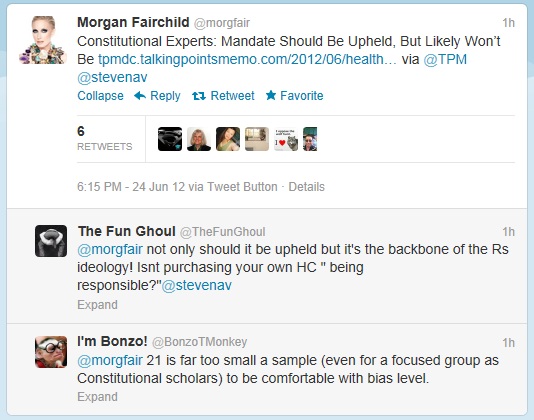
Morgan Fairchild has grown her following organically, and can drive user engagement more effectively than users with more followers who grew their following through other means.
Nevertheless, you’re more likely to catch a fish if your pond is full of them. As mentioned earlier, it also plays a huge role in perception. Several authors have made a career out of growing their Twitter following, and many professionals have parlayed a perceived online influence into business growth. It’s not going to hurt to have more followers, and no matter what other bloggers say, almost everyone wants more. Here are 8 tips to help you get more followers, keep them, and expand your real influence.
Optimize your Profile
Twitter profiles are relatively simple and straightforward. There is no better way to guarantee that you’ll never get more followers than by leaving a big ol’ egg as your avatar, and leaving your profile empty. You only have 160 characters to sum up who you are, what you do, why someone should follow you, or what they can expect your tweets to consist of. Make sure that users who view your bio understand what niche you’re targeting.
If you’re affiliated with a popular brand, make sure to mention that. Other than that, be original and use your own best judgment. I like the idea of including a shortened link to a page on your own website dedicated to giving more information to people who are interested in your description. Use keywords in your bio whenever possible. You can optimize your Twitter profile for search in the same way you optimize a web page. Think of your name as the title and your bio as a Meta description. Just like in SEO, exact match domains will do better than unrelated hyperlinks.
When it comes to your avatar, name and location, the most important thing is to stay consistent in your branding. Use the same profile picture that you use on other popular networks, and make yourself as recognizable as possible. Michael Q Todd’s profile photo stands out because he has big green hair. It’s instantly recognizable in a Twitter feed. Twitter profiles that are branded as a person get lots more followers than profiles branded as a business. The avatars are small as they move through your feed; use a headshot, and check to make sure that it works well in all the places an avatar will be displayed. I’ve also found that a professional picture will do wonders for attracting followers. Wear a suit if you’re in business, and it doesn’t hurt to show your feminine side if you’re a woman.

Michael Todd’s green hair is hard to miss in a Twitter stream.
You get one link, and a place to add your location. Make sure to fill in your location, and use the most relevant domain associated with your brand as your link. Most of the interaction on Twitter takes place in a user’s feed, but prior to following the majority of users will check out your profile page. Create a custom background for your page – this is the perfect place to include your business logo. When it comes to profile design pay attention to your color scheme and placement of background elements. What looks good on your laptop may not work on a desktop with a lower resolution.
Weave your Web
The link you use on your Twitter profile tells users that you’re associated with that website. When I visit that website, it works much better if there is link or button that points back to your Twitter account. Don’t stop there, most social networks offer a place to add your Twitter ID. Before long, there will be a link that connects Twitter on your Facebook, Twitter, Google +, LinkedIn, and every other social profile associated with your identity. It helps users trust in your identity, which is more important than you think on the Internet.
Take it a step further and set up accounts on websites like Twylah, About.me and Xeeme. Twylah creates a formatted page for all of your tweets that can be indexed in search engines. Xeeme and About.me are both places where you can create a list of all your social profiles. When you mention your name in blog posts, hyperlink it to your Twitter profile.
Interlinking isn’t just an important step for the sake of your followers. Search engines run on backlinks and extract a lot of context from the associations with social profiles. As search evolves, it is becoming even more important to properly identify yourself on popular networks. Rel= Author tags let Google know that I’m Adam Justice, the prolific Social Media blogger and not Adam Justice, the cross dressing night club DJ. Of course there’s nothing wrong with Adam Justice the cross dressing night club DJ, but getting confused with him wouldn’t be an efficient way to attract pertinent followers. As the schemas get more complex, it will only become more important to link yourself correctly across platforms.
Involve Yourself in the Conversation: Be Active
Now that you’ve set up an appropriate profile and made sure followers can find you from your other web haunts, it’s time to use Twitter the way it was meant to be used. The most popular tweeters are the ones who own the discussions in their niche. Every tweet you publish, every @mention you make, every hash tag you use and every time you re-tweet someone you’re extending your social graph. You’ll never know when that extra extension will lead to a new follower. Since you’re involving yourself in conversations that are pertinent to your niche, you’re going to attract the right followers.
Join in Tweet chats and trending topic discussions. These are like the town square where everyone in your community is gathering. There are most likely hundreds of weekly chats already established in your niche; if there aren’t, establishing one is a perfect opportunity for you to become a premiere industry thought leader.
Even though each action is another opportunity to extend your following, it’s important to limit your quantity to preserve quality. When you’re participating in a Twitter chat treat each response as a status update. Make sure that your tweets can stand on their own as a piece of short content. Don’t treat your Twitter stream like a chat room. That’s not what it’s for, and there is no quicker way to alienate a ton of your followers.
Curate Quality Content
My favorite Twitter accounts aren’t celebrities, and most of them have fewer followers than me. I prefer tweeters like Kevin Henney that curate quality content streams full of articles and other content that is pertinent to my interests. When you’re developing your own Twitter content strategy, observe the quality over quantity advice you hear so often, but try to publish at minimum three tweets every day.
As your following grows, you’ll start to gain more followers from re-tweets and recommendations. This is when your quality will pay huge dividends. The best Twitter feeds are often recommended to users as an information resource.
Don’t just focus on the latest articles from popular websites, try to share great articles that your followers may not have otherwise found. Share content that is intrinsically viral like pictures, videos, slideshows, infographics and lists. You can use resources like Alltop, Reddit, and Stumbleupon to discover content that is appropriate for your followers.
Follow Others
This is the primary means for increasing your follower count for most users. It is an unwritten rule on Twitter that following back is the courteous thing to do, especially if your stream is relevant and interesting. Some users may not be active, and some users may have different thoughts about Twitter best practices, so don’t worry too much about those that don’t follow you back.
You’ll find lots of users to follow in your everyday Internet use. Being involved in industry discussions will help you discover hundreds of users who are active in your niche. Follow your favorite bloggers, and the people leave comments on their posts. Wefollow and Twellow are directories that list users by category.
One of the best mechanisms for finding relevant users to follow is through Twitter’s own native search. Not only will you find relevant users, you’ll find active users who have tweeted in the last few days. One of my favorite strategies is to skip searching category keywords like “Social Media” and instead search for related keywords that are currently trending. I gained a few hundred highly targeted followers this month during the Blog World Expo by following users that were tweeting with the #BWENY hash tag. Since most of these were users who were actually attending and tweeting from the event, it excluded the mass of automated bots that have categorical tags programmed into bots.
It’s not against Twitter’s ToS to use automation in conjunction with your Twitter account, but it is in no way a best practice. In fact, Twitter is the first community I’ve ever been involved with that didn’t ban automation outright. It is however against Twitter’s ToS to execute excessive following and unfollowing of other accounts. “Follower Churning” as Twitter calls it has been a popular strategy for gaining followers for years. It’s a tactic you should avoid at all costs. Not only could it get you banned, but you’ll find that your following will be more valid if you let it grow organically over time. Facebook recently applied its EdgeRank algorithm in a way that punished the users who abused the fan page likes system. You never know when Twitter will roll out similar measures.
If you can’t help yourself, most users place the maximum follow limit at around 100 per day. I have it on good authority that the maximum number of followers you can engage without raising Twitter’s suspicions is closer to 400, if you’re following tons of users every day. Twitter has placed a hard cap on how many users you can follow in a single day (1,000), and altogether (2,000 until you attract enough followers to reach an unspecified follower/ following ratio).
Optimized Your Campaign
Now that you know what you have to do, it’s important to be consistent in your efforts. Tweet every day, and respond to mentions. Rome wasn’t built in a day, and no matter what anyone tells you, neither was a valuable Twitter account. It won’t take hours out of your day, and most people enjoy interacting with their followers on Twitter. Within a year you should start to see some tremendous results if you abide by these practices.
So it’s going to take a while, but like with everything else, there are ways to increase your efficiency and make this strategy work faster.
Optimize your Content
Assuming that a certain piece of content will resonate with your followers is not enough. Pay attention to what does and what doesn’t strike a chord with other users. Investigate the most popular users in your niche and find out what it is they’re tweeting that gives them an edge. Twitaholic is a decent tool to figure out who is popular in your industry. If a user built they’re following primarily through Twitter, odds are the type of tweets they publish are popular with other Twitter users.
You can also use an application called Tweet Effect to examine which tweets prompted other users to follow and unfollow you. If you’ve stayed true to your strategy, you’ll probably find that inappropriate and off topic tweets weren’t as popular as tweets that were targeted. You may also learn things about your following that isn’t as apparent. Humorous or inspirational tweets may resonate with a following that you considered serious or irreverent.
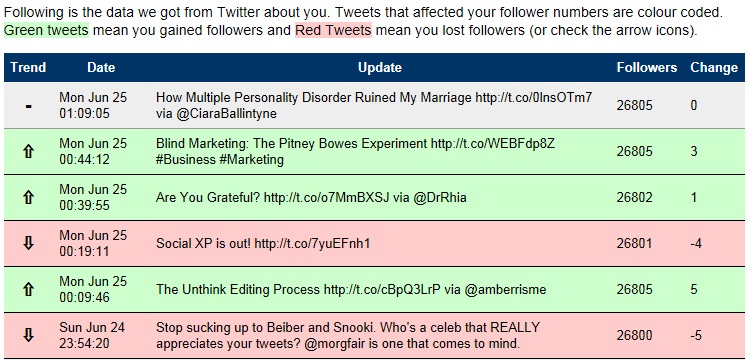
Through a recent query with Tweet Effect I learned 2 valuable lessons. First of all, that the automated Paper.li app is probably driving away followers. Second, that no matter what your niche is on Twitter, never say anything negative about Justin Bieber.
Tweet When Someone is Listening
Users aren’t going to be exposed to every single tweet you send out. Tweets have a very short half-life as far as online content goes, so only expect a small percentage of your followers to actually see your Tweets. It is possible maximize the number of impressions your tweets get by knowing when your followers are online. Tweriod examines the times of day your followers are tweeting, and translates it into a graph that that shows the best times of the day, and the best days of the week to send out your Tweets.
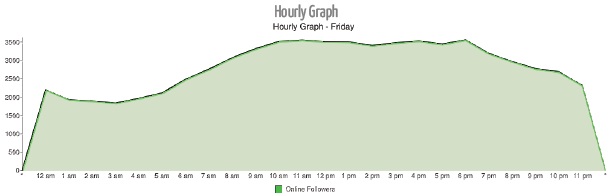
Tweriod analyzes your followers Tweeting patterns to determine which times of day are the best times to tweet. According to my report, anytime between 9am and 6pm is optimum for tweeting during the weekdays.
You’ll still need to tweet multiple times per day to reach the maximum number of followers, but you’ll have an idea of what time the majority of your followers start using Twitter, and what time they stop.
Optimize your Following
Like I mentioned earlier, most average users consider it courteous to follow back the users that follow them, and there is a hard cap for how many people you can follow without having a near equal number of followers (this is a big reason why it’s considered courteous to follow back). You’ll need to prune inactive users, and sometimes users that refuse to follow you back if you aren’t attracting additional users organically.
There are several tools that will help you take inventory and clean up your friends list from time to time. The two that I prefer, are UnTweeps and Tweepi. You can set a timeframe, such as 60 or 90 days, and unfollow any inactive users who haven’t tweeted in so long. Tweepi also has settings to unfollow users that haven’t followed back, as well as a tool to reciprocate follows. This is especially useful when you’re subjected to Twitter’s following limits.
Now that you have a clear cut plan about how to get more followers on Twitter, what are you waiting for? Make your account as good as you can make it and make some noise. The more visible you become in your niche, the more likely influential users are to follow you. Remember to avoid public confrontations, and try to keep from crossing any lines. The more followers you attract, the more likely such things will become a big deal. Social Media is one area where “If you can’t say anything nice, say nothing at all” is good career advice.
What are your strategies for attracting followers? Has anything we haven’t mentioned given you better than average results? Most of the literature on attracting Twitter followers holds to the same formula, mostly because it works.

- Blogging Isn’t a Rocket, It’s More Like a Roller Coaster - August 19, 2025
- Value vs. Expectations: The Fight for Startup Survival - July 31, 2025
- The Evolution of Marketing: From Catalogs to Cat Blogs - November 8, 2022
- How to Make a Tweet This Link - February 5, 2022
- Dramatically Improve Marketing Results with Advanced Analytics - September 20, 2021
- The Next Chapter for Social Media Sun - June 4, 2013
- Optimizing Your FAQ to Maximize ROI - December 5, 2012
- Weapons of Influence and Klout’s Role in Marketing - November 17, 2012

I havent paid attention to any of this stuff and I probably should. It all seems so damn complicated…
Great post – thanks for sharing.
Thanks so much for the article. The Twitterverse is now bit less confusing.
A lot of the stuff you’ve mentioned I’m already doing. I’ll be off to check Tweet Effect though! I do follow users to encourage a follow-back (although I don’t EXPECT a follow-back) but you could call that organic to the extent that I only follow people who are in the same niche as me – and therefore who I might expect to have something to say I’m interested in, and who would be interested in what I have to say. Half of getting people to follow you is to be noticed, and following them is one of the fastest ways to do that – as long as you have interests in common. I agree with your 100 a day limit on following for those who insist on mass following a lot (and I don’t, only about once a week if that).
I disagree with a tip, from my little corner. Using services that duplicate your content like Twylah, About.me and Xeeme make your SEO rank lower. I don’t tweet 24/7, no single human could, but mine is always real and my poetic vision. I may not fit your style, but I am not looking for a certain number of followers. I want to find creative people who read or who just are positive. Like any conversation in the real world we are only doing something if we add value, information, and what I call CARING, the real secret to social. I can spot auto anything right away and it gives me a cold impersonal branding manipulation feeling. Brands can use twitter in marvelous methods- connecting customers withe needs to the solution maker offline, or offering deals and “corralling a positive posse.” please quote me on the posse and come on down for a hug online
You’re actually right Caroline, but About.me and Xeeme do not duplicate your content – they only link to your profiles, which helps your SEO if the profiles are DO Follow. It also gives crawlers context. When they see your Facebook page and your Twitter ID on the same page, they’ll know the 2 profiles are related.
Caroline, we’d all like followers that actually read and stay positive, but I’d venture to guess that even you have followers who rarely use Twitter, use automation in some form, and aren’t an optimum blend of the qualities you’ve mapped. If for every 10 followers, you wind up with 1 that fits your criteria for a “perfect follower”, or even an “adequate follower”, you need 100 followers to pull together a group of 10 great ones. Sometimes quantity can indirectly affect quality, and I’d also guess that the more followers you had that engaged with you, the more you’d find that you want to engage with yourself!
good info! I’d just like to add that you can have TWO links now on your Twitter profile. One in the URL space, and one in your actual bio itself. I suggest shortening it (to take up less space), and customizing it using bit.ly, to track clicks. You can see mine at @RachelintheOC:twitter
Hey Rachel, good to see you, and good idea… but I actually mentioned using two links in the article 🙂 ” I like the idea of including a shortened link to a page on your own website dedicated to giving more information to people who are interested in your description.”
The part were I said “You only get one link”, I was running down the optional profile fields (You have description, location, name and link). For your link, I suggested using your website, or the most pertinent website you’re affiliated with. For the extra link in your description, I suggest using a page you make JUST for your Twitter followers (which I don’t have lol, but I’ve been working on it for a few weeks now sparingly). I sorta have the same setup – one is my personal marketing blog, the other is SMS where most of my time is dedicated.
It was kind of confusing how I explained that though, if you didn’t catch it you’d miss it, and I probably should have formatted it to explain that I was going over Name, Description, Location and Link fields, in order. Great minds think alike though, I love your additional suggestions.
One thing that didn’t occur to me then, the Link field is Do Follow. I believe links in the Description are No Follow (without taking the time to run through source code, does anyone know for sure?) The links on Twitter are fairly powerful, so it is an opportunity to get some link juice. Since your Twitter profile will appear in the SERPs when people search your name, it’s probably more valuable as a backlink for a page that is branded to your personal identity. There is multiple combinations of which links to use where, it’ something that everyone will have their own right answer to.
Why do people keep recommending Wefollow ? That directory is dead, inaccurate and with old data that is not updated.
I still think it’s a great directory. You’ll find the people who have tenure, and that’s increasingly important, especially in marketing. I think it’s fairly accurate, and it’s probably a better directory because it’s broke, and the flood or irrelevant one-timers can’t cram it full of low quality feed, Just my opinion though.
Fairly accurate ? Go to any category and compare the number of followers they have listed for each guy / company in the directory then go to that guy / company twitter profile ..you’ll see that there is a huge difference in numbers, and the bad part is that you can’t do anything to update the data.
Number of followers isn’t a very important dataset for a Twitter directory. The most important thing is if the users should be in that category or not. If the only problem is inconsistencies in follower numbers, you don’t have much of a problem.
First of all, it’s logical to assume that if the directory says I have 5,000 followers, that I probably have more than that now – not less. Second, number of followers doesn’t tell you anything about a user. You can buy them on Fiverr (Even though those followers are worthless), you can automate adding to grow your followers, and you can target #Followback tags in searches to improve your conversion rate. When users do this they’ll have huge followings, but in terms of influence, they have very little.
I am guessing that the owners don’t maintain the site anymore. There are still lots of great users lists there, and I can vouch for the ccuracy of the listings as it pertains to interest.
Great, great post Adam. This is helpful information for anyone who is on twitter, new or old.
Awesome! I’m starting to use these valuable tools. I never knew about some of these. Thanks for posting!
A ton of the stuff you’ve referenced I’m as of now doing. I’ll be set for check Tweet Impact however! I do pursue clients to energize a pursue back (in spite of the fact that I don’t EXPECT a pursue back) yet you could consider that natural to the degree that I just pursue individuals who are in indistinguishable specialty from me – and in this way who I may hope to have a remark I’m keen on, and who might be keen on what I need to state. Half of inspiring individuals to tail you is to be seen, and tailing them is one of the quickest intents and purpose. I concur with your 100 daily limits on following for the individuals who demand mass after a great deal (and I don’t, just about once per week if that).