
 With Google’s latest project they have used dozens of existing technologies to develop cars that can drive without user input. It seems like science fiction, and it begs the question “what do autonomous cars have to do with search engines?”
We’ve almost become accustomed to seeing the tech giant getting involved in projects that at the time seem irrelevant to their business model. When they first launched Gmail it was heavily criticized as a bad business decision because it wasn’t related to search, and e-mail was supposedly a dying medium. It is fitting that you’ll likely use your Gmail ID to log in to your autonomous car in a few years, much like how the Gmail ID ties all of Google’s platforms together right now.
Autonomous Autos is Just Good Business
The reason that Google’s self-driving auto is completely relevant to their product offering is because it integrates several of Google’s products and patents into a monumental advanced technology. Having a production vehicle that can perform all the necessary tasks it takes to navigate our highways safely in conjunction with human operated vehicles will have vast positive consequences on our transportation system, making other company’s inventions such as Apple’s intuitive response touch screen seem irrelevant.
How Does it Work?
The current model uses data from Google Maps and Google Street View along with several sensors and a complex artificial intelligence system to drive cars at a speed limit stored in its map. There is a $70,000 LIDAR sensor on the roof of each vehicle, radar sensors on the front of the vehicle, a position sensor on one of the rear wheels, and video equipment to monitor inside of the car.
Altogether there is currently $150,000 in additional equipment required to operate one of these vehicles, and Nevada is the only state with any existing provisions related to the legal use of a driverless car. With no way to know how soon these cars could enter production and the fact that competitors will almost definitely develop similar vehicles based on Google’s design when the price of components comes down, since it uses mostly existing technologies, Google is investing a lot of money in a project that doesn’t guarantee to help anyone except the drivers that will eventually drive from San Antonio to Dallas while sleeping.
Our highways will be safer and more efficient. By changing all of our cars into autonomous vehicles the compounded savings in fuel efficiency, lost productivity due to traffic jams, and medical costs stemming from accidents are hard to fathom. Google will automatically become a major part of one of our largest national industries and receive both direct and indirect revenues from their work for a long time to come. Autonomous vehicles will directly spark several positive changes for drivers, and indirectly have positive effects on everyone; even cultures that do not have roads or cars.

A Toyota Prius outfitted with Google’s Driverless Car hardware, including the roof mounted LIDAR, on a testing path.
Indirectly, there will be a constant growth in the use of other Google products since consumers will increasingly come to rely on their Google ID to access Google Autos, Google Wallet, Google Talk, Google Public Wifi, and hundreds of other products that we’ll see developed as Google transitions from a search giant into the firm that takes us civilization into the silicon age.
What’s Good for Google is Good for the Goose
All of these changes will likely occur in the future, and it’s easy to see how these new technologies will help us individually, and even as a civilization. It’s not as easy to realize that Google has been protecting our interests since the day they launched their search engine. Everyone likes to think of Google as money grubbing corporation that pushes ads on consumers and feeds off the violation of user privacy. When you consider how Google’s various developments have affected how we use computers and devices everyday, their technologies have improved our experiences considerably.
The integrity of Google search is built on the quality of the results. If their breakthrough algorithm didn’t provide superior results, we may be talking about Alta Vista’s autonomous back scratcher today instead of Google’s magic car. If they didn’t update the algorithm to stay ahead of black hats and webmasters that exploit flaws in the system, the quality of the results would degrade quickly. If they hadn’t cultivated an open culture for app developers with Chrome and Android, joined with Mozilla and W3 to implement HTML, and work with other search engines on the new Schema, they wouldn’t be in the position to compete with ingrained entities like Ulead, Adobe Flash, Apple and Microsoft for the selection of web standards.
You could argue that the quality of the search results and creating new standards to push out older models owned by competitors are both selfish endeavors, but they’re crucial practices that may have been neglected if Google wasn’t the catalyst. Some of the biggest contributions that Google makes to the Internet are often behind the scenes.
Practical Problems, Thankless Solutions
One of the biggest problems facing a search engine or any online engine that aggregates results from other websites is the potential for malware and virus infection. Google has developed hundreds of systems that effectively find, target and remove malicious results, possibly saving every user of their search product from being infected several times each day.
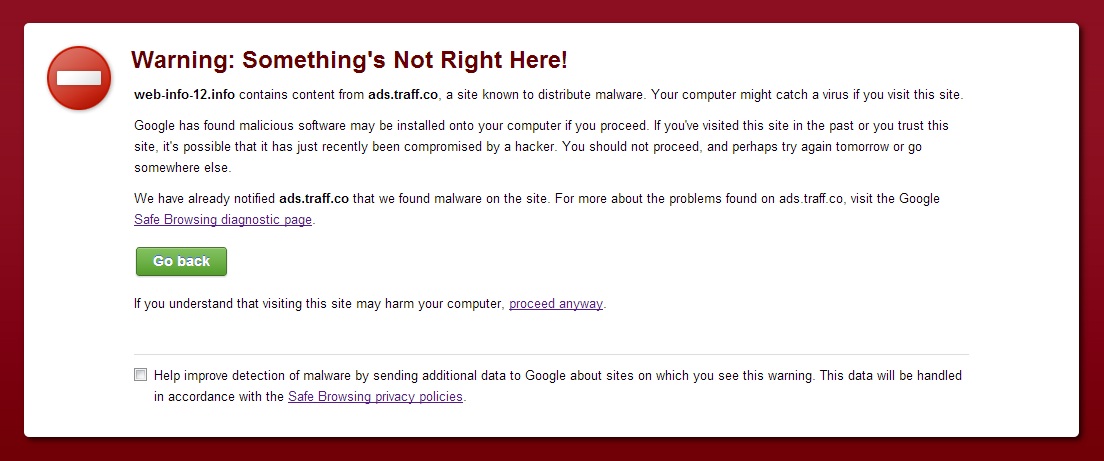
Google has several early warning systems in place to alert users, and ultimately remove search results that point to pages that are believed to be infected by malicious code.
The malware problem has an even larger potential to cause damage when it comes to online advertisements. Google Ad Words controls a large portion of the online ad market, and each ad has the potential to embed a virus on thousands of websites. Google’s operating procedures and approval process has made Ad Sense one of the most trusted ad servers in the world. There are hundreds of resellers that pull their ads straight from Google because it would take an extremely large investment to create an ad service that works as well as Ad Sense.
Their due diligence when it comes to ad service does more than keep their own ads from becoming infected. The Internet is a great example of public institutions, private investment, and donated time coming together to make an expansive and complete information network. The Internet wouldn’t have near as many pages, or the quality, if there wasn’t a method of monetization similar to Ad Sense. Traffic has become a commodity, and advertising is the only way to monetize the traffic itself. As websites try and improve the quality of their information products to draw more traffic, we have Google to thank for the atmosphere that makes such work worthwhile for the publisher.
To Infinity and Beyond… to Kansas
Google is one of the last companies that consider research and development the most important aspect of their business. That’s the primary reason that Microsoft, Facebook and Apple haven’t enjoyed the type of continued success across media that Google has mastered. Whether it’s installing the world’s fastest Internet in an abandoned Kansas sewer system, mapping the surface of the Earth, or even mapping the stars, Google has boldly ventured to go where no tech conglomerate has gone before.
In a world where an energy Drink company realized huge publicity dividends by vying to compete with our national space program, being bold has its advantages. Google’s business cycle includes buying or developing dozens of small projects, analyzing their future viability for both profitability and product advancement, and then cutting lose the projects that do not make the cut. Products that would be perfectly viable for other companies just don’t seem so great when you’re mapping the universe or developing driverless cars.
Google Wave, Jaiku and Google Buzz may have had their uses, but they didn’t play a pivotal role in improving the quality of life for everyone. Google’s new caliber of project does just that, and I’m glad that they’re undertaking these projects while they have the opportunity. If no one else is going to try to solve the problems of the future, I don’t care if Google knows what I search for.
How about you? Do you think Google’s Privacy concerns negate all the positive research and advancements that their projects bring us?

- The Evolution of Marketing: From Catalogs to Cat Blogs - November 8, 2022
- How to Make a Tweet This Link - February 5, 2022
- Dramatically Improve Marketing Results with Advanced Analytics - September 20, 2021
- The Next Chapter for Social Media Sun - June 4, 2013
- Optimizing Your FAQ to Maximize ROI - December 5, 2012
- Blogging Isn’t a Rocket, It’s More Like a Roller Coaster - November 19, 2012
- Weapons of Influence and Klout’s Role in Marketing - November 17, 2012
- The Biggest Problem With Inbound Marketing Blogs Today - November 16, 2012

Stellar article. Spot on in so many ways. I am excited to see where Google is heading with all the knowledge and technology they are innovating every day.
Thanks Amanda! I think we need companies like Google doing this. If I know they’re going to work on big problems, I’m a lot more inclined to use G+, and buy an Android device. I can definitely see why you and so many other smart social media regulars love the Google brand! For the first time in a long time, I’m jealous of the folks in Kansas City lol.
Are you actually on Google’s payroll? Not trying to be funny. I’ve genuinely wondered.
No. I just enjoy their products and innovations. 😛
Haha I think there might be something there. Amanda would be the perfect product evangelist for Google consumer products. Somebody should bring it up to Larry Page at the next board meeting.
Google is Love/Hate to me. The Highly Educate do not respect Professional Recruiters, But I love technology, and like where Google is headed. Money talks and they have deep pockets. And in recruiting, If they don’t want to be a client company, They become a source company. and all talent comes to work until they want their own toys to flourish and leave. Like all big companies the early in are rich, the rest are just employees. albeit high paid employees climbing Glass Ceiling….that’s just how it is.
I’m a long-time Google user, but personally, I’m less and less enthralled by Google as time goes by.
I began using their search engine when it was largely the domain of geeks on places like slashdot. This would have been 1998 or ’99. I still remember the first “easter egg” on the front page, where on Mother’s Day, clicking on one of the O’s in their logo would take you to a gallery of all the employees’ moms. And there were only about 40, if I recall correctly. They were small, smart, and had hands down the best search engine on the planet, long before the general population knew about them.
So believe me when I say that I’m a long-time fan of Google.
There are two keys to understanding Google
One is to understand that they are not a search business. They are an advertising business.
The other is to understand the underlying foundation of so-called social media: If you’re not paying for a service, you’re not a customer. You’re the product.
Absolutely everything you do with Google’s services adds to an ever-growing database about your connections and activities – who you are, what you do, what you like – to a degree that most people simply don’t internalize and can’t comprehend.
Through your Android phone, for instance, Google knows where you go. That’s probably not surprising. But they also can determine who might also be there with you. They can probably ascertain what time you go to bed. They know where you eat, what stores you shop at. They know when you’re late for work, and how fast you drive. They know when you’ve gone to the hospital, and when you skip school. They probably know when you forgot their phone at home – but they might still determine what you were up to when you happen to appear in the background of a photograph that someone uploaded to Picasa – complete with timestamp and location data.
That’s just a fraction of all you could do with just the geolocation data from your phone.
And they use this to filter what you see, and determine what ads to put in front of you, and they sell the use of that facility to others.
“Don’t be evil” is all well and good as a slogan, and particularly endearing to the generally somewhat libertarian tech crowd. But ultimately, they are in business to make money and they do that through the most base of services: advertising.
It’s exciting to see all that Google does – their 20% free personal-project time is legendary and a great idea generator for things to throw at the wall, just to see what sticks. But ultimately, their business is really applying their massive database to sell their product: eyeballs for their advertisers to parade their wares before. Google is not the only one doing this, of course – it’s the very basis of all social media.
The promise of technology is to make our lives better, but it’s important to realize that many of the very best minds we produce – folks coming from MIT and Stanford and other fine institutions – are focused on the rather uninspired question of how to get more people to click on more ads. I, for one, think that’s very, very sad.