
 A man sat at a metro station in Washington DC and started to play the violin; it was a cold January morning. He played six Bach pieces for about 45 minutes. During that time, since it was rush hour, it was calculated that thousands of people went through the station, most of them on their way to work. In the 45 minutes the musician played, only 6 people stopped and stayed for a while. About 20 gave him money but continued to walk their normal pace. He collected $32. When he finished playing and silence took over, no one noticed it. No one applauded, nor was there any recognition.
No one knew this at the time, but the violinist was Joshua Bell, one of the best musicians in the world. He played one of the most intricate pieces ever written with a violin worth 3.5 million dollars. Two days before his playing in the subway, Joshua Bell sold out at a theater in Boston and the seats averaged $100. The whole thing was a social experiment set up by the Washington Post.
You can take many lessons away from this experiment, the most obvious being that you should always take time to stop and smell the roses. In the rush of our everyday life, just how many things do we miss because we’re consumed with our routine? The Post concluded that Bell’s sellout performances are in part due to the marketing, and packaging Josh Bell as one of the premiere violinists in the world in effect makes him one of the best violinists in the world.
After studying this for some time I accepted that our society has bred the double standard, and it is as disturbing as it is interesting. Changing ingrained social norms is seemingly impossible, so philosophizing this experiment is worthless. The first thought that came to me was that sometimes the medium is as important as the message. I’m not talking about Google Plus vs. Twitter; they are pretty much the same when you boil it down. (Comparing Facebook and Twitter is a far stretch from a subway and an Opera House)
Play to Your Audience
The commuters were not the best audience, and the subway was definitely not the best venue for a violin concert. Effective online marketers deal with this every single day, matching optimum conditions to a pre conceived campaign. You want to catch Internet users at a time that is most conducive to getting them to perform a desired action. Getting articles shared on Social Media has become a huge goal for most blogs, but when people are checking their Facebook news feed, they are usually more involved with the Facebook application than they are with articles that were shared by their friends. Recent studies have shown that the often overlooked weekend engagement could be a sweet spot for engagement.
This is one of the reasons that Search Engine Optimization has remained a force in online marketing. Those users are actively searching for content that is at the very least similar to yours. It’s also a good reason to recruit recurring visitors. When someone has devoted a certain amount of time to interacting with your website and its content every day they become much more engaged than a drive by speed read from Twitter.
Is Your Venue the Ritz or the Days Inn?
As a web developer or blogger you want your website to be the theater in Boston, but most web traffic isn’t looking to attend the performance of a concerto. You know who would have done much better on the subway? A newspaper salesman. While the commuters obviously didn’t have time to listen to the violin (and most of them would have probably kept walking even if they knew who Josh Bell was) they had the time to buy a Newspaper and take it with them. Josh Bell may have made 32$ in the time he was playing, but hardly anyone consumed his media. I can’t say that the newsboy would have made a lot more money, but the commuters would have probably consumed his media at a time that was more opportune for them. If Joshua Bell had handed out free CDs, a lot more people would have been able to consume his media that day.
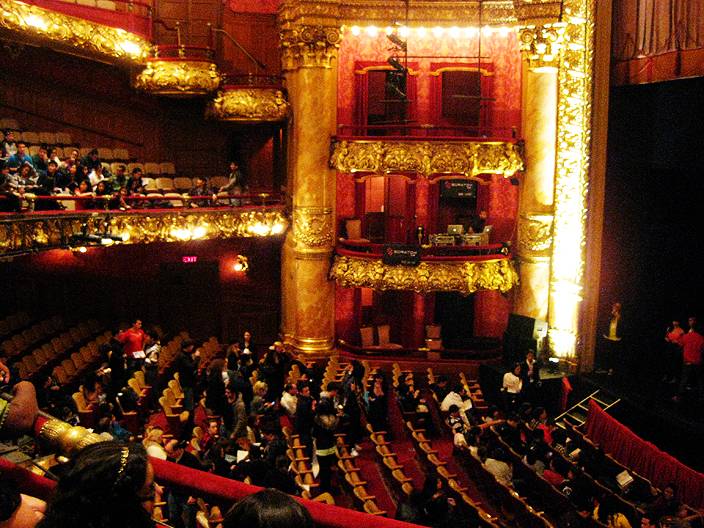
Most people would love to listen to music in the Colonial Theatre in Boston, MA, but when you need to get your workout in, you’re more likely to listen to music on an iPod.
I’m not saying that you send your visitors away immediately with a printout or .PDF file, your website is going to be available to most consumers anywhere and anytime these days. That is one of the great advantages of the Internet. Your online content is the periodical that can be consumed at a more opportune time.
•Consider your audience and venue.
•Target the ratio of drive by visits and in-depth research explicitly with your content.
•Make it possible to consume your content on a wide variety of devices.
•If you give something away, let people know about it.
What I’m saying is to consider your audience and venue. Be thinking about the interaction that takes place during all stages of your marketing. What does the Tweet that is exposed to thousands of commuters look like? For those who buy the newspaper, what kind of impression does your website have on them? Is it effective and well-targeted, or are you Joshua Bell on a subway?
This post originally appeared on Social Media Marketing from Adam Justice

- The Evolution of Marketing: From Catalogs to Cat Blogs - November 8, 2022
- How to Make a Tweet This Link - February 5, 2022
- Dramatically Improve Marketing Results with Advanced Analytics - September 20, 2021
- The Next Chapter for Social Media Sun - June 4, 2013
- Optimizing Your FAQ to Maximize ROI - December 5, 2012
- Blogging Isn’t a Rocket, It’s More Like a Roller Coaster - November 19, 2012
- Weapons of Influence and Klout’s Role in Marketing - November 17, 2012
- The Biggest Problem With Inbound Marketing Blogs Today - November 16, 2012


”
The whole thing was a social experiment sent up by the Washington Post.” – he was not trying to get attention or make money. The goal was to see if anyone would notice…and yes, I would have stopped to listen and probably missed a couple of trains. Marketing is not what made him great. Skill, talent, and passion are. Greatness does not need marketing to be great but without marketing, the public would not have known about that or any other of his concerts. Also, a nit-picky correction: one does not “attend a concerto”.
You would have, but didn’t. Thousands of other people didn’t either.
There are thousands of great violinists, and to the average person there isn’t a big difference between a very good violinist and an exceptional one. There are violinists better than Joshua Bell that do not sell out concert halls. His brand sells the tickets much more than his ability to play. His ‘Greatness’ is as much perceived as it is real. Technical ability has failed the majority, but when you combine that technical ability with the correct audience who appreciates it, the right message that will resonate, and the right format to let them pass it on, you can beat the odds.
In the same vein, there are hundreds of bloggers that are better than the most popular ones. To the average person, the difference between exceptional and good enough is not important enough to spend a dozen hours every day scouring the Internet for a blog the moves them deeply while also entertaining and teaching them. They’ll usually just start reading the most popular blogger on a subject, regardless of any shortcomings. You have to have a spark to start a fire, even if you have all the fuel in the world.
Hey Adam –
Great post, I really enjoyed it. I think a lot of what you say is right on target but I think the marketing is more important that the venue in this case.
Having seen Joshua Bell twice this summer, in my opinion he is far from being the best classical violin player in the world. As some one who sells music online, I can say that he is one the most popular and best selling classical musicians. He is also young, good looking and very well marketed. There are many reasons why or why not a musician becomes popular apart from talent.
When you have a product that most people are not qualified to make a judgement about, like classical music, you must tell people why the product is so great. When you go to the art museum they tell you something about the art and the artists to help the average person understand what is special about the art. I think if someone held a sign next to Bell while he played that said “This is one of the most famous classical violin players in the world. Tickets to his concerts sell for $100” he would have had a mob around him in no time. When you tell people they are getting something of value for free, you will usually draw a crowd. You should see the the way people line up to get a trinket worth about fifty cents when they do product demos at the supermarket. For most people, the music is only part of the draw. Where I live, there are many places where one can see excellent classical musicians for free, yet Bell still sells out.
And to mh_76 Adam does not say “attend a concerto”, which would be incorrect. He says “attend the performance of a concerto” which is fine.
Anyway, great post, very thought provoking. Love the title and the way you use it to wrap up at the end.
Thanks Andrew. You’re right, I was using the venue as a metaphor for the medium and marketing – the packaging, like you pointed out could have changed this whole experience. They wanted to stress people’s nonchalance, but all it would have took is one person recognizing him.
That’s really cool that you’ve actually saw him live. I should have consulted you on this article (I actually wrote it a while back, but decided to share it here on SMS). Even though I’m not totally ignorant about classical music, someone who actually enjoys watching it would know more about the intricacies of how well Bell is actually percieved at shows, or by fans in public. Also, I had the type mh pointed out, I changed it after the fact. It’s not that I didn’t know what a concerto was, but for some reason I thought you could use it like you could opera or something – you go to the opera to watch an opera.
Glad you stopped by Andrew.
to mh_76 – my mistake – I did not realize Adam had changed it.
Hope I didn’t come off like snob or something about the music – someone gave me tickets – and he was very, very good but not one of my all times favorites. The term “opera” can be confusing because it can mean either a piece of music or the place where the opera is performed.
I usually think great marketing is more important than a great product, but I am cynical. Anyway, thanks for the article and discussion.
Haha I wish I had more chances to see classical performances. Honestly, I have heard Josh Bell play but nothing really struck me about it – and I’ve heard classical performers that I knew were just great. Technical ability doesn’t always make someone great – I think it could have as much to do with song choice and who knows, it could even be the instruments (I have a theory that somewhere there is a 39$ violin that sounds just as good as Bell’s Stradivarius). I wish I would have known more about Bell just for when I wrote this article – I feel like I probably got the big picture right, but it’s odd that he’s supposedly this good looking kid, and I expected a panhandler.
and I promise you I’d be mindful of edits!
I couldn’t agree with you more on this. You have to look at where your audience is if you want to build a presence. For example. A Tech website would want to hang out on Social Media, Forums, and other Tech Sites. As long as they aren’t spammy of course.