
 This week Klout launched their most far reaching update to date, complete with a site redesign and algorithm overhaul. Your Klout score probably saw a change, one that Klout claims reflects your influence more accurately. The majority of users I’ve spoken to have saw an increase in their score, but many users who put the most stock in their presence on Klout lost points. If you still haven’t checked your own Klout score, I suggest you at least take a look so you’re aware of it.
My Klout score shot up to 79. In the past 2-3 months I have strongly urged my friends to stop wasting time trying to game their Klout scores. I have friends who spent hours every week participating in +K rings, decided who was worthy enough for a Twitter response via Klout, and posted updates on Facebook with the sole purpose of luring others into commenting. Meanwhile I ignored what I thought seemed ridiculous, used social media to converse with people who I like (despite their Klout score), and spent my hours maintaining and improving my blog (Socialmediasun.com), which in turn extended my real reach and influence.
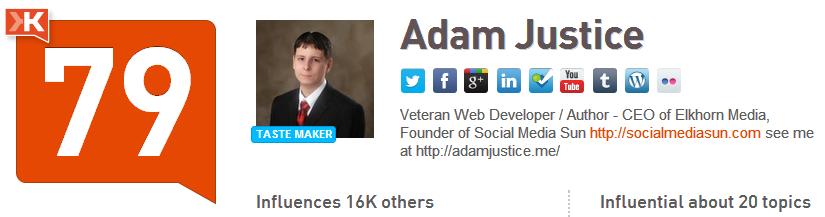
I feel like a douchebag doing this, but I also think that I’m obligated for the good of everyone to use the window of time that my Klout score is higher than most to relate hard work, quality content, and tangible production to how it got there.
I could actually notice my reach increasing, and the level of offers from other businesses, websites and individuals improving. Is it a coincidence that my first radio interview pertaining to Social Media Sun was recorded on the same day that Klout said they noticed that I was more influential than they previously thought? If you want a high Klout score and it will make you feel better, I want that for you. The disparity between tangible influence and some Klout scores a few weeks ago left me shaking my head though. Their latest update addressed that considerably; I’m not going to recommend that you spend an hour a day visiting the Klout site, but I do feel validated that they’ve placed a higher value on measureable influence.
Why Does it Matter?
If you are spending more than a couple of hours online each day, your purpose should either fall under work or leisure. Usually the users who are aware of Klout fall under the work category, even if they do not attribute that work to a paid job role. The most important thing is to ask yourself what your purpose is. Are you trying to establish yourself as an expert in a certain niche? Are you developing a website that needs to attract users? Are you campaigning online for a charitable cause? Why do you need online influence? Why is it important for you to generate the kind of response that reflects what Klout is trying to measure?
If you don’t have a purpose or tangible goals, you need to find something else to occupy yourself with. If you do have a purpose, but have found yourself more worried about how many re-tweets you got yesterday or about how high your Klout score is, you need to re-examine your goals and create a strategy that you can follow.
I highly recommend making a website your base of operations, and funneling people from social networks to a place you control. Facebook pages are great, but they are very limiting as a publishing platform. Social networks may be where Klout gets their measurements, but to create sustainable online influence that you have some say over, you’ll need to operate from a place you have some control over. If you’re just working on personal branding, buy a domain name for your name and set up a blog relating to your profession or hobby. There are users who wield considerable influence with a loose network of social profiles – but they’re the exception.
Be Social
The people who find themselves at the helm of an active niche community are the ones who put the time in. You need to engage with the people who are interested in what you’re doing. If you’re really lucky, they’ll have similar projects and goals. One of the best examples I can think of is Gini Dietrich and her loyal minions at Spin Sucks (of which I proudly count myself). She has probably met a lot of the regulars on her site in person. She has conversations with her community over several different networks, and when she posts they get involved. The guest posts on her blog do not get near the feedback that her posts do, and it’s because her readers go there for Gini.
That’s the kind of immediate community that translated into support for her book tour. Her supporters also have supporters, and that is the essence of online influence. It’s the result of relationships built over time, giving more than taking, being able to relate to a wider audience, and just being nice to people.
Focus on your Content
If you’re being social and you’ve found your tribe, you’ve got the basic support that it takes to create reach. Your tribe is going to share your content, but to appeal to a wider audience you’ll need to put some effort into what you’re creating. Engineer content that will get shared, be unique, and employ your message. I can write the smartest E-book that was ever published, but if it isn’t easy to digest and share then it won’t make it too far out of my tribe. Your tribe is like a spark and top notch content is like gasoline; you can burn down a whole industry with that kind of firepower.
Be Consistent
The half-life of quality content may be a week tops. You’ve just burned down a whole forest too, so mimicking your recent success too closely will ensure that you won’t have the fuel to be an arsonist twice. Be creative and set out on another topic, media channel or attach your name to someone else’s soup of the day. Whatever you do, you need to be consistent and remind people that they acknowledge you for a reason.
Aim High
You won’t expand your influence by keeping the same routine on Facebook and Twitter every day. Don’t get me wrong, you need to have some sort of routine, but your strategy should be focused on constant advancement in addition to a consistent routine. The whole idea of analytics is to notice when something works so you can add it to your routine, and measure new tactics so you can move on if they don’t. If you’re a blogger, you should aim to be a blogger / author by this time next year. If you’re an author, you should be an author / television host by 2014. If you’re already on all available media channels, you need to innovate something entirely new. Guy Kawasaki and Seth Godin both developed awesome new websites after publishing several books (Squidoo and Alltop). They could have just kept on publishing books, but I can’t quickly name any of their contemporaries who held that strategy. Influence will grow as long as you can maintain relevance.
Keep from Limiting Yourself
The primary reason that Social Media Sun grew so quickly is because I had experience using multiple promotion techniques. I didn’t neglect SEO to focus only on social media, and I didn’t discount any groups or networks just because someone else told me to. I’m also always on the lookout for new promotion channels, and did my first radio interview related to the website earlier this week. I was a little nervous (it was for an AM radio show in Dallas, and in case you didn’t know I have a southern accent thicker than glacier ice), but I’ll do it again next month. Don’t spread yourself too thin, but don’t fall victim to your own bias or let insecurities hold you back.
Do You Like Yourself?
Here’s an exercise for you: pick out the three worst things you’ve done in public over the past six months. It could be anything from getting a little heated in a discussion over global warming to parking in a handicapped parking spot. Now, ask yourself if you’d support and vouch for someone if all you knew about them was concerning those three incidents. Flip the script and if you were saying global warming is real, think that your hypothetical stranger was challenging it. Do you communicate in a way that doesn’t seem at all hostile or antagonistic? Now, write those three incidents down on paper and put a fake name at the top. Find three other people who you consider influential and ask them if they would be inclined to respect the person you’ve written about.
Everyone makes mistakes, and I’m not the best person to teach you this lesson, but communication is the very basis of online influence. If you communicate poorly, you’re at a disadvantage from the start. If you were truly objective, most people aren’t going to have a flattering picture painted for this exercise. You’re actually better off than you think – I’ve found that communities like to identify with mistakes. Being able to own up to your shortcomings makes you way more relatable than someone who does little more than re-post motivational quotes. At the same time, you need to communicate effectively as possible. Respect everyone’s right to speak, validate their opinion, and enjoy the fact that by clearing up your own communication you’re becoming more accessible and limiting the poor communication you’re receiving from others. Sharing your thoughts and opinions is a mandatory part of online influence so I suggest working on your conversation tact at every opportunity.
Influence and Success Trumps Klout
By focusing on the things that started you on your social media journey you’ll most definitely build influence. As long as Klout succeeds in refining their algorithm, it will always net you a positive gain with them. Better yet, you’re going to be so overwhelmed with accomplishment that you’ll stop worrying so much about your Klout score.
So basically my advice for increasing your Klout score is to ignore your Klout score. Klout’s purpose is to accurately measure online influence. To do this they need to discount users who are trying to inflate their scores. Every time they make their application better it’s going to make it harder to affect your score with basic tactics; you’re going to need tangible influence which is a product of respect and reach.
Instead of spending 300 hours operating a +K ring this month, write a book about the subject you’re wanting to be influential about. Resist the temptation to add ‘Red Bull’ to your list of topics just because Klout is giving away Red Bull T-Shirts. Focus on the things that brought you to Klout in the first place and making yourself an authority in that area. Dedicate your online time investment to making unique content of the highest quality. Klout isn’t accurate, but there are practical applications for its use. That doesn’t mean you can ignore or be mean to people with a Klout score of 25. Your interaction is still a story, and if the story is fantastic enough, it will eventually find its way to users ranging from 50-90.
So What Does Klout Equate to Influence?
No matter how much I say that building your real influence over time is the best way to increase your Klout score, some people are still going to look for a quick fix. Joe Fernandez’s first observation is as true as ever. The components of online influence are your Network, your Reach, and the Amplification factor you can derive from that.
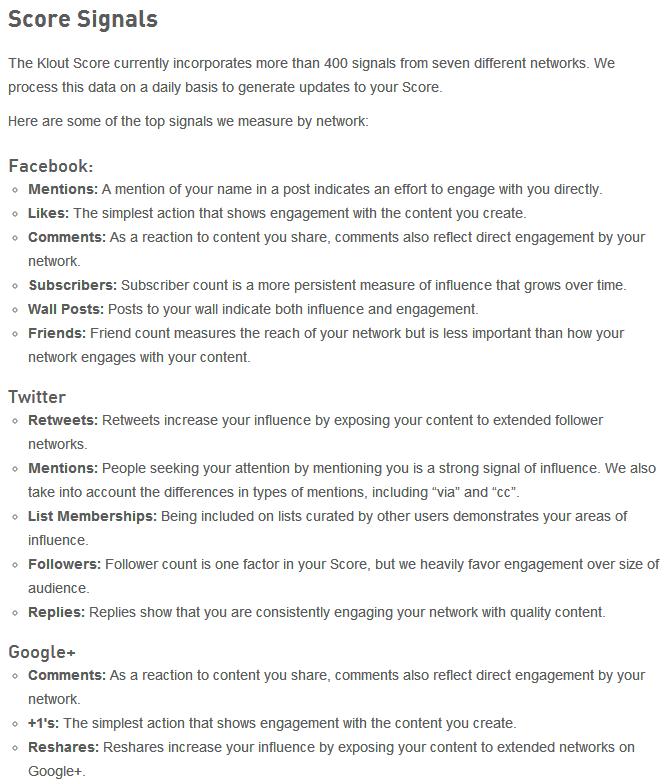
By explicitly listing the signals they use to increase Klout scores, users who wish to game the score now have a recipe to follow. Over the next few weeks a lot of people will try to make themselves a Wikipedia page and they’ll beg for LinkedIn recommendations.
Network: How influential are the people in your immediate network, and more importantly who respects you enough that they are willing to submit to your influence? How many people in your network will vouch for you?
Reach: How far can your message spread? Your network extends outwards like a root system. The whole idea is to increase the number of people who get the message from you – the rest is dependent on your niche and how well it resonates with the general population.
Amplification: This boils down to your content. If your name is attached to something, make it as helpful, entertaining, authoritative and unique as possible. High quality content gets shared regardless of how close to the source it is.
You cannot choose who you truly influence. You aren’t going to be everybody’s cup of tea. Be grateful when you connect with someone that you clique with. To weed out gamers Klout has placed more importance on reaching a broad audience and real world influence. Having a large group of friends with high Klout scores isn’t going to propel your score into the stratosphere like it once did. Creating content that inspires sharing will though.
Finally, I would like to quote Klout to make this real to you. “The best strategy for obtaining a high Klout Score is to simply create great content that your network wants to share and engage with.” –Understanding the Klout Score

- Blogging Isn’t a Rocket, It’s More Like a Roller Coaster - August 19, 2025
- Value vs. Expectations: The Fight for Startup Survival - July 31, 2025
- The Evolution of Marketing: From Catalogs to Cat Blogs - November 8, 2022
- How to Make a Tweet This Link - February 5, 2022
- Dramatically Improve Marketing Results with Advanced Analytics - September 20, 2021
- The Next Chapter for Social Media Sun - June 4, 2013
- Optimizing Your FAQ to Maximize ROI - December 5, 2012
- Weapons of Influence and Klout’s Role in Marketing - November 17, 2012

Well, my score jumped from 61 to 78 with the new algorithm, so clearly it’s more accurate. 🙂
I don’t think my score should be 79 when someone like Mark Schaefer who has been as visible as the Bat Signal for the last Year is only 73 – but whatever. My score was high when it was 65, and after this week I’ll go back to not worrying too much about it.
Congratulations Scott!
Yeah, my score jumped from 46 to 58; I think most people saw an increase, whatever that means.
If you feel like a douchebag, you can always confirm it on Klouchebag: http://klouchebag.com/#decibelplaces where my score is higher than on Klout.
I call Klout, Kred, and Klouchebag the “Social Media KKK”
Please give me +K about Social Networks on @klout. Thanks! http://klout.com/plusk/1172728/1172728_6231772432486389545?n=tw&v=plusK_ask
I’ve noticed that my klout score increased from 61 to 69
Glad to hear it Lucas. I wish that a Klout score would help with the single thing that it should, relations with the Klout company itself lol. I’m going to ask Joe Fernandez for an increased level of insight, as a part of the media.
Thanks for helping clarify the kout events of this week, Adam!
Thanks for reading the blog Susan! I didn’t mean to point out the weaknesses in some people’s online strategies, but I’m really trying to help.
Interesting news. Holding steady, but I’m not gaming any system. In fact, a bit less on Twitter. Keeping up with friend interactions, blogging and radio shows. Good luck to everyone.
Glad to hear it Debbie. It sounds like you have a great strategy, whether you’ve formally mapped it out or not.
There is no need to game anything. No one ever got anything for gaming Klout. One of my friends who was at one time a well respected thought leader has been trying to justify buying Twitter followers lately, saying that it is hurting him by not doing it while other people do – which is ridiculous; getting identified as someone who purchases fake Twitter followers is one of the most damning things you can do in Social Media. The reason why he thinks others are gaining an advantage by buying followers? Because it helps their Klout and Kred scores (which it likely doesn’t since the simplest algorithms can weed that type of stuff out). That kind of thinking shows a major level of misunderstanding of personal branding , social media and the Internet as a whole. I don’t know where some people are getting their best practices from, but this Klout thing really brings the ignorance out in people. I’m not stating an opinion when I say that Klout is a vanity metric that doesn’t warrant several hours a day for managing; I’m stating the obvious, that some people cannot accept, but desperately need to. Sometimes I feel like confirmation bias is so prevalent in the first generation of Twitter users that teaching them ethics is as useless as talking to the wind.
Twitter followers can be really useful to have. I made a status update about this 10 days or so and lots of great examples came out from different people about how having more gets them into newspaper and magazine articles, blog posts, lists on sites like hashtracking etc. I cannot imagine it would help Krred or Klout but for some people having more will help achieve their goals. I would not do it myself but would definetely not blame nor criticize anyone who does it. No one who understands Twitter or Social Media gives any credence to follower counts but “mass media” certainly still does and while they do why not? It is just a way of advertising your brand like any other form of marketing. Some people build a follower count by following others who automatically follow back. Pretty much the same really isn`t it?
Your points about having a great blog are very true
This is very good clarification and I like the cheat sheet on signals. I have often wondered about FB because I use it to keep track of social media but only post lightly (in content and volume) for my family. I use FB and Pinterest personally and G+, LinkedIn and Twitter professionally.
In the end I look at the Klout number as I do my weight, IQ and cholesterol. I want to keep them all in check and healthy but I would never allow myself to be measured or judged in value or influence by a number. However…
I still don’t trust that when I go on vacation for two weeks soon that I won’t be back to zero!
Thanks Adam
Anneliz
a2zmp3songss.blogspot.in
Great article!
Your suggestions roughly follow the advice I provide in my book Return On Influence Adam. I say the same thing. Stop gaming the system. Surround yourself with great people. Create and share great content. Be kind and helpful. The influence will take care of itself.
Yeah, I actually saw somebody quote some things from your book after I wrote this, and I was thinking the same thing. I’ve even been quoting what ever it was they were saying lol, but I can’t remember the exact context. I’m definately going to have to get that book this week.
Ok, I remember what it was now. Content Strategy. That you can’t have the type of influence that content creators have without having a content strategy. It’s so obvious, but it something that you don’t really see until you actually sit down and think about. I kind of see it like the 3rd tier of influence; what gets you outisde your immediate connections.
Mine didn’t change 🙂
Has anyone heard of others having trouble with Klout in regards to capturing ones data from sites Klout follows. I am very strong in Linkedin participation and heavy into foursquare, yet nothing is captured. I have emailed the big incoming email klout box and get a typical “There is something wrong and we will look into it”. Any suggestions would help. Thank you. Any people to email at Klout would also help
Eve,
The Klout algorithm weights each network based on its popularity and potential for reach. Activity on LinkedIn, and especially Foursquare, is worth far less than influential activities on Facebook or Twitter. This is why Klout shows Facebook as most people’s most influential network, even when they have twice as many engagements on Twitter. You’d likely need somewhere between 3-10x the engagements on LinkedIn because potential reach (and also the influence score of those you influence because their reach is also impacted- so amplification as well) .