
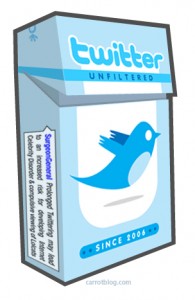
 Twitter announced last week that they planned to tighten restrictions on spamming and automation. Normally this is publicly considered good news by everyone affected, but there have been several bloggers and pundits denounce the move. Instead of increasing penalties or targeting the actual spammers, Twitter has filed lawsuits against five 3rd party developers who were involved in the creation of automated spamming tools. The most well-known of which is Tweet Adder.
It all comes down to ethics. At the heart of the bloggers’ argument is that a small group of spammers are misusing the tools that help “marketers” plan and execute their social media campaigns. This is a completely backward view that social networkers and every kind of online community has had since public Internet access became available: that when developers launched an application, ethical use only included use that originated from the application’s own proprietary interface.
Using a program that gave you an undue advantage was even worse. Before there was TweetAdder there was adding trains, Friend Blaster, macros and a whole other assortment of automation tools to use on everything from MySpace to Yahoo! chat rooms. They were universally known to be unethical, and many of the advantages are the same you’ll get from a program like Hoot Suite and Tweet Deck.
Automation Makes a Re-Tweet SPAM
The fact is that the ethics involved with automation and bot use have been skewed for the past couple years. Social Media platforms can place blame on whoever they want, but there is one culprit who deserves much more blame – a social network named Twitter.
As recently as three years ago, practically all Internet users agreed on the ethical problems with bot use. Those that didn’t understand the ethical implications entirely, but still knew that there was something inherently wrong with using a different interface to access applications and games that gave the user a decided advantage over their counterparts. Most importantly, the people who did use bots didn’t admit it. Rather than face public criticism they kept it to themselves and forced the platforms to bust them, and then take the necessary disciplinary actions. Denial confirmed the notion that it was unethical, and that the user knew it.
Twitter Made its Bed, Go to Sleep Little Birdie
It was around this time that Twitter started to get bigger. With the integration of mobile and the unique aspects of the 140 character micro blog, Twitter allowed 3rd party developers to openly distribute applications that had the ability to totally replace the Twitter interface.
Up until that point the only accepted programs were aggregators that could combine several platforms into a single interface. Some Twitter users had several thousand followers, and were following several thousand accounts themselves. It made sense to allow programs to optimize the experience any way they could. The bots became “tools” to users, scheduling became a popular practice, and automation started to become accepted. At least at first users remembered that there was something inherently wrong with having an advantage over other users.
When Does a Tool Become Black Hat?
Social Media, and especially Facebook and Twitter, were becoming more popular by the day. The regular black hats had their bots and macros, but as the lines blurred between the capabilities of a tool like Tweet Deck and a bot like Tweet adder, regular users began taking advantage of programs that were explicitly allowed, although limited, in Twitter’s end user license agreement. After all, why wouldn’t they? It is playing by Twitter’s own rules, and there you can do a lot of cool things with the right program.
Social media marketing experts who were looking for an edge stumbled upon the more powerful tools, and it wasn’t long before they were recommending them in their books and even selling them as an affiliate on their websites. Twitter condoned it all for the most part; they just asked that users keep automation to a reasonable amount.
Naive Newbies See it as the Gold Standard
As users who weren’t familiar with the wars that prior social networks and other platforms had fought against bots and macros in the past started taking to Twitter en mass. The lure of social proof and potential profits from garnering a massive following was more than enough lead them on a search for the tools that could replicate the success that others were having.
Since Tweet Adder allowed users to make a sizeable commission from each sale, the active networkers weren’t even trying to keep it a secret. What’s more striking is the fact that it was no longer taboo; people were recommending it publicly and hardly anyone denounced it. Twitter was still growing at a spectacular pace, so why police something that helps inflate your user numbers so much?
Being an Expert Means Exploiting Advantages?
The current crop of bots and Twitter apps are popular because they can automate actions on social networks that lead to growth. The growth can be transformed into added engagement, and the engagement can lead to profit. Is all fair in love and money? Greed has allowed the use of automated Twitter accounts to blossom among users just the same as it allowed Twitter itself to turn a blind eye to their users who were both padding the numbers and flooding the network simultaneously.
You can’t argue that the whole idea of supplementary Twitter applications is to give you distinct advantages over the official interface. You can reach followers on the other side of the planet who would normally be asleep during your active hours, you can multiply the number of actions you’re capable of completing on any given day, you can live a normal life and still portray yourself as a Twitter super user, and you can use advanced filters to make it all more efficient. The question isn’t whether or not it works, it’s whether having access to the social networking equivalent of steroids is ethical; and since it isn’t ethical, how could all of the professionals, and Twitter themselves, turn a blind eye for so long?
Twitter Sold it’s Horse for a Faster Cart
Growth has slowed for Twitter, and it’s obvious that they have a spam and bot problem. When five percent of users are responsible for 75 percent of all tweets, you know there is a little too much automation going on. So Now that they’ve plateaued, they need to curb the use of such programs before they can reach a larger audience. Even though marketers who frequent the same “Warrior Forum” that hackers and bot enthusiasts frequented five years ago have accepted wide scale use of automation, the general public still gets an icky feeling when they find out that they are the only ones present at a party that is seemingly jumping. People don’t like to be fed by robots, and Twitter knows it.
Applications like Twitter are best if ALL users are limited to the same User Interface that was developed as part of the application. The user experience is better, it puts users on equal footing and removes automated spam altogether. Twitter’s acceptance of all these programs that can post to their platform is an Internet first. They relinquished that control, and that’s why I don’t see them winning a lawsuit for that very reason. They didn’t create this monster, but they invited to stay in their home and fed it high protein gruel. Now that it’s as big as it has ever been, it’s going to be nearly impossible to eradicate. When a user sees other people exploiting “tools” at every available opportunity, they aren’t going to stand idle while others are passing them by.
Tweeters are Addicted to Convenience
Even if Twitter wins all five lawsuits, users are so used to using automation and bots that they’ll search fervently for a replacement and a programmer will reach out to meet that demand in spite of prior lawsuits. Some users will try and compromise and justify it; Even though your average marketing disciple is plenty smart, the prevailing culture has warped their sense of ethics.
I’ll be honest here: even though I recognize the ethical conundrum we face when using a superior interface, I’ve always felt like ethics are better saved for serious matters. I don’t care if you sent your tweet from Buffer App, Tweet Deck, the official Twitter app or from your iPad in the bathroom. I accept the current culture of tweet-botting and scheduling, and as long as average users don’t form a mob, I won’t try and hide my use of programs like the Buffer App, Triberr and Ifttt.
Do you use automation in your social media strategy? Have you ever had a strategy that didn’t involve some level of automation or scheduling? No matter what anyone says, it is historically unethical. The question is why do we let convenience dictate when the platforms write the rules? Are online ethics so flimsy that a single company’s culture can alter them? And how important is it to maintain ethics when the crime is spam; non-violent, and some would say victimless. If you were the judge, do you rule in favor of Twitter, who has obviously had a change of heart due to their bottom line – or do you rule in favor of the third party apps that spent time developing programs that were accepted by everyone at the time, even though they wouldn’t have been a few years prior?

- Blogging Isn’t a Rocket, It’s More Like a Roller Coaster - August 19, 2025
- Value vs. Expectations: The Fight for Startup Survival - July 31, 2025
- The Evolution of Marketing: From Catalogs to Cat Blogs - November 8, 2022
- How to Make a Tweet This Link - February 5, 2022
- Dramatically Improve Marketing Results with Advanced Analytics - September 20, 2021
- The Next Chapter for Social Media Sun - June 4, 2013
- Optimizing Your FAQ to Maximize ROI - December 5, 2012
- Weapons of Influence and Klout’s Role in Marketing - November 17, 2012

Great article. Its a fine line between using ‘tools’ to help streamline the twitter experience, and using them to spam. I see absolutely nothing wrong with BufferApp and especially triberr, but believe that automated follow and unfollow software might be crossing the line…
I use a little automation, but it is all through tweets I’ve approved previously and scheduled myself. Things I know will add value to my followers. This being said, there is still nothing that replaces personal engagement and interaction, too. Great article, Adam!
I’m with Amberr. I schedule posts I’ve read, filtered and feel are relevant to my niche. And I don’t see anything wrong with that aspect of automation. However- thinking that you can schedule to provide content and just walk away makes for a bad social media strategy. Scheduling content is just the first part of it.
The only automation I use is through Triberr but I manually approve what I approve. I’m not a techie and am so new to this game (3 months in) that I’ve been oblivious to much of the etiquette…but, thankfully I’ve not been using these things anyway because I’m not sophisticated enough in my knowledge to do so. 🙂
Please learn the proper use of an apostrophe. I want to share this with my social media students but can’t because when they see “professionals” using the contraction for “it is” in place of the possessive “its” along with other 5th grade grammar errors, they think they don’t need proper grammar, spelling and punctuation in the workplace.
I do use automation through Tweetdeck (which Twitter now owns). But I limit that automation – space it out over hours, not minutes. I don’t use it for sales pitches – I use it to share information with people during times I can’t necessarily BE on Twitter. And I always try to intersperse it with more personal communication.
To me, the problem isn’t necessarily the ethical dilemmas you laid out, but just how effective are social media and social media marketing if you’ve got nothing but bots talking to bots? It’s stupid. After a while, naturally, people tune out and find real people to talk to.
I use Hootsuite to add posts that I pick so they can be dispersed every hour or two, but that is pretty much it except for Buffer when I find something great. Other than that, I really just
like to chat with people.
I have a blogger pal on Twitter who prefaces her #wws and #ffs with “Real People” – as opposed to “follow me I’ll follow you” auto mentions. There’s another example of gaming systems. You too can have 25000 followers, none of whom engage or care about what you do, so why bother? Ego I guess. Sigh.
I don’t know that I am against setting up accounts to share things found throughout the day during the wee hours. I can see how draining keeping up with all social media is unless you have nothing else to do. Why not have a helper program? We are ultimately mobile now – technically speaking we can be available to answer tweets responding to updates that were prescheduled. Yet even as I write this I can see how it would get easier to justify leaving Twitter on autotweet – one of those slippery slopes.
My only “automation” is posts on FB update my Twitter account and my tweets show up in the margin of my Linked-In. An Triberr – but that’s not automatic anymore anyway:) I am a case apart from many others in that I don’t sell anything but support for animal welfare. Cause-related auto-tweets seem less offensive, but I could wrong;) Good post – thanks for writing this!
Good article exploring a very interesting subject.
At it’s heart I think social networking is about conversation and you can’t automate or delegate that!
However, content sharing is really important too. I do automate some of that, your tweet for example about this article will be semi automated. I’ve read it and will “buffer” it for RT later.
My own posts from my blogs get automatically tweeted over time.
But the automation for things like tweet adder I do find frustrating.
As you say, is this really worthy of a lawsuit?
Automation makes my RT spam? Sorry, disagree. I have 30 minutes twice a day to breeze through twitter and find that a lot of my friends have posted interesting things that I want to retweet or reply to. But 10 or 20 retweets and a dozen or so personal replies to comments all coming together?
Now THAT’s spam!
So I may read the articles and stick them in Buffer, or use HootSuite to schedule them 30 minutes apart, or an hour, or 3 hours or whatever. But I am the one who has decided the content to RT and when – based on my audience – and I schedule it myself. Some of my followers don’t have a huge number of followers themselves, so my activity could overwhelm their news feed, even if I try to space it out. In that instance I encourage them to unfollow me if it if just too much info.
I don’t use automation to market at all, I do mostly face to face networking for that. On Twitter, I am either sharing information or chatting with friends. Either someone will like what I talk about and find out what I do, or not. Too many tweets? Unfollow me. I promise my feelings won’t be hurt.
See Susan we’ve been conditioned to consider how we use Twitter normal, but it’s not ‘normal’ or ‘average’ in the least. Twitter itself even perpetuated some of the undesireable actions that they’re now trying to police. That was actually the meaning of this article, not a tirade against automation. Twitter has skewed the awareness that users used to have regarding what constitutes average or normal, and what constitutes an advantage. I use roughly the same programs as you for automation I would assume, but it’s important for your own networking awareness to realize how your own Social Media use differs from average users. Keep in mind: none of our friends are average users lol.
There is a program available that will give you a rough Idea if you’re using Twitter in a manner consistent with a “good follow”. http://klouchebag.com Counts English Misuse, Re-Tweet abuse, Use of 3rd Party Apps, and Anger to score your account on how much you misuse Twitter.
I’m not going to unfollow you for using automation, the only considerations I have is the actual content a person serves up, and the person’s personality / integrity themselves.
(How funny that you have a banner ad right above this box for Twitter Automation Software from Wildfire). I use automation, and I do think there is both an ethical way and unethical way to use it. Regarding Tweet Adder, I think there are a couple of features in it that could be called ‘questionable’ (such as spinning Tweets) that I have never used, which could be taken out of the programme without ruining its value to ethical users. All in all, it’s a fabulous piece of software that helps many, many non-spammers deliver their content and follow relevant users. I like the fact that I can queue up a nice Twitter list instead of having to click, click, click each person manually, and I really don’t see that this kind of automation is an ethical problem at all.
I feel more than a bit miffed with Twitter that they have to go and sue software developers who are giving valuable tools to legitimate Twitter users, rather than appeal to them resonably to alter specific features that might be abused.
I also feel more than a bit miffed with Twitter for saying on their blog that they are ‘Shutting down spammers’ and playing the ‘holier than thou’ card about being ethical, while at the same time sending me UNWANTED sponsored Tweets from companies like McDonald’s (possibly the least ethical company on the planet) and there’s no way to stop them. To me, THAT is spam.
It is an ethical problem though Lynn. These programs have been widely denounced as unethical since long before Twitter even existed. Everyone that sees Tweet Adder as an ethical answer is a product of the Twitter generation. We’re all supposed to use the same interface, have no advantages, and use the program as it was designed. Twitter is basically saying that now, with the exception of Hootsuite
https://support.twitter.com/articles/76915 , but they still have an extremely lenient view of automation and bot use. As you can see though, even popular programs are at odds with Twitter’s suggested API use
https://dev.twitter.com/terms/api-terms .
There are great uses of automation, but those are programs developed by airlines and such. Automated following and tweeting however is a major breach of ethics. It’s a clear one too. If this was any platform before 2007, you would at least acknowledge that it wasn’t the most ethical thing to do (you may still admit to it). Any applications that mimmicks Consumer Engagement (which is the role the Twitter dashboard plays) is in extreme danger of being shut down in the coming months
http://www.techerator.com/2012/08/twitter-takes-control-with-new-api-rules-plans-to-limit-access-for-third-party-clients/ . They’re going to allow “value added” applications to continue. They allowed the automation to pad their numbers, but when it comes to the general public, a large percentage would unfollow you in a heartbeat if they knew that there was no chance you’d see their tweets because you’re a robot – you followed them with software, and you tweet automatically. I’m not going to condemn you for using bots, but Twitter didn’t create ethics, or bots for that matter – and the only group of software users I’ve ever known to claim that using bots was kosher is Twitter botters. You should own it if you’re going to do it – explore the implications of a bought and paid for advantage, and the uneven interaction you’re engaging in with your followers that use the basic Twitter platform in the manner it was meant to be used. It’s almost like you’re using a different network.
Hi again, Adam,
I agree wholeheartedly that we are facing an ‘ethical’
problem, but I don’t believe we as a culture have yet come to a consensus
as to what we mean by ‘ethics’ in this case.
Twitter’s lawsuit is about SPAM. And here we have an
equation that is not equal on both sides of the table: Automation does not
necessarily equal spam; however, spam is pretty much 100% dependent upon
automation. I wish to God that Twitter is successful in eradicating spam and
hackers from the Twitterverse. They are a pox on the landscape and I report
them every time I get one of those @ messages. I also tell people when I see
their account has been hacked (when those horrible DM messages come through
that say ‘someone’s saying horrible things about you,’ etc.). If Twitter could invent a way to wipe away
this kind of stuff for good, I’m all for it. And if the ONLY way to do that
would be to make ALL automation software a violation of TOS, then I’m all for
it. However, I can’t help but feel this is an extreme and unnecessary measure.
I do not at all see how automation makes a Twitter user a
spammer or ‘unethical’. I’ve been using Twitter for four years now. I have four
different Twitter accounts because they all Tweet to completely different
audiences about different things. Twitter’s official policy does not say people
cannot have more than one accounts; they only object to people using multiple
accounts for overlapping purposes. Spammers
have multiple accounts for identical
purposes. I’ve even seen some shamelessly blatant ‘help wanted’ adverts on tech
forums looking for people to do this.
Since 2008, I have legitimately built up a following of tens
of thousands of followers. I gain an average about 75-100 new followers a day,
which is a small percentage and hardly ‘aggressive’ or inorganic considering my
time on Twitter. I do follow back, and only unfollow if people become inactive
or are (yes) spammers. Because I have so many followers, I filter my content into
streams on either TweetDeck or HootSuite, so I can ‘absorb’ it better (which is
a practice supported by all of Twitter’s ‘officially sponsored’ software
programmes).
I understand (and agree) with you when you say, ‘the general
public still gets an icky feeling when they find out that they are the only
ones present at a party that is seemingly jumping.’ If we’re not engaging at
all, what’s the point? But I do automate my content because I have a LOT of it. I have also been auto-following specific lists,
and I use a variety of different programmes to keep my list of followers up to
date (i.e., get rid of inactive followers, etc). This level of automation gives
me the TIME to go onto Twitter (sometimes via HootSuite or my smartphone) personally every single day. I read
other people’s Tweets, make lists, reply to people, ask questions from people, RT
people and share articles other people have posted. Engaging on Twitter is part
of my every day business (and personal) life. Frankly, if I did NOT use
automation, I would not be able to engage to the level I do. Perhaps therein
lies an irony, but it is the truth.
To me, to say that automation is what is ‘unethical’ because
some people use it for spamming is kind of like saying cars are unethical not
because they cause pollution, but because some people use them to rob banks.
And again, if we are talking about ethics and spam, when
Twitter sends me (or anyone) promoted Tweets/adverts from accounts I expressly
do NOT follow, why are these considered ‘advertising’ rather than ‘spam’? I would think the defence would bring this anomaly up in court, if
they were really on top of things.
The one thing I’m sure we are both in agreement on is that
the results of this case will be both interesting and influential. The
decision from this court case is going to be extremely important, because it is
going to define ‘ethics’ in a way that can potentially extend to all social
media interaction. I can only
hope the honourable presiding US District Judge Susan Illston is given enough evidence to look beyond the
surface of this case, lest the outcome open up a Pandora’s box that changes
social media in ways not currently apparent.
Thanks for writing this blog post, Adam. The discussion is a
highly important one at these cross-roads in social media history.
Well Lynn, the part that is unethical isn’t automation, it starts at the point that using a different interface or applications brings about a decided advantage over users that use the proprietary Twitter Dashboard.
I think the one thing I would like you and everyone else to take away is that with 300 Million users, we are a terribly insignificant minority as marketers. There isn’t an effective forum for Twitter users to set ethical standards, and the majority of users have likely never hard of Tweet Adder. They know about Spam, but they don’t know about the thousands of users that autonomously mimic a real person. Without that necessary communication (Twitter may have set it up by design), we become farther removed from ethical standards of the past, and more inclined to accept the ideas that Twitter puts forth in blog posts and press releases. For some reason, the gap between any given user and the user base as a whole and is growing wider.
Thanks for stopping by Lynn. You did a good job in articulating your thoughts here, and I hope you stop by again soon!
Adam