
 Facebook is easily the most popular social network, and even users who have very little formal computer training know how to access their news feed, send a message, and search for long lost friends. Mark Zuckerberg’s simple application has become known for breaking demographic barriers to the extreme; whether you’re 18 or 80, the heavily praised interface and the fact that you can network with your friends, grandparents, and children is a testament to Facebook’s ease of use.
There is however a few buttons you may have never pushed when it comes to Facebook. A few settings you’ve never changed, and maybe even some contact you’ve missed. Here are five Facebook features you didn’t know existed.
Other Messages
One of the primary uses for Facebook is to send messages to friends. It’s a little more convenient than using e-mail, and you’ll often get quicker responses. Since Facebook patched the instant chat widget into the messaging system, the real time aspect has taken on a new light.
Most users don’t realize that they are sent dozens of messages every year that they’ll never receive. In the beginning, the “Other Messages” folder was a reservoir for messages sent directly from Facebook Brand Pages and messages that the network considered spam. Since the algorithm updates, the removal of branded pages’ ability to send messages, and Facebook’s focus on limiting connection to users that you know outside of Facebook, the “Other Messages” folder has become a catchall for pretty much any message that doesn’t come from a friend.
If there are too many links, the message will probably end up in the other folder. If you do not share any mutual friends with the recipient, your message could end up in the other folder. If you have been tagged as a careless user with a history of contacting others who weren’t receptive, you’re more likely to end up in the other box.
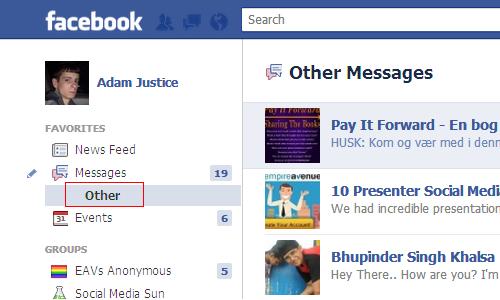
Facebook's Hidden Inbox has kept more than a few important messages from reaching their intended recipients. I almost missed a trip sponsored by Chrysler that is valued at about 2,000$ because Facebook thinks I don't want to talk to anyone I'm not a friend with!
I have had a few legitimate messages quarantined to the “Other Messages” inbox, and until a few months ago I didn’t even know it existed. The hotlink isn’t visible on your home page, and only shows up in the navigation when you are in your regular inbox (a page where your focus is almost exclusively in the center of the page).
To access your “Other Messages” inbox, first open your messages. There will be a hierarchy sub-category appear below the “Messages” hotlink for the “Other Messages” folder. Don’t be surprised if there are legitimate messages from people you know, possibly a year or more old.
Aaargh You Fluent in Pirate?
As Facebook expanded they effectively integrated dozens of world languages, making the world’s most popular social network truly accessible to an International user base. You can set your preferred language to Spanish, Deutsch, French, Afrikaans, and any other language that can be translated from English.
Most people don’t realize that there are several versions of plain ol’ English available to spice up your Facebook account. Tired of speaking like a normal person? Try switching your language settings to English (Pirate). This setting takes you back to a more swashbuckling, plundering version of English.
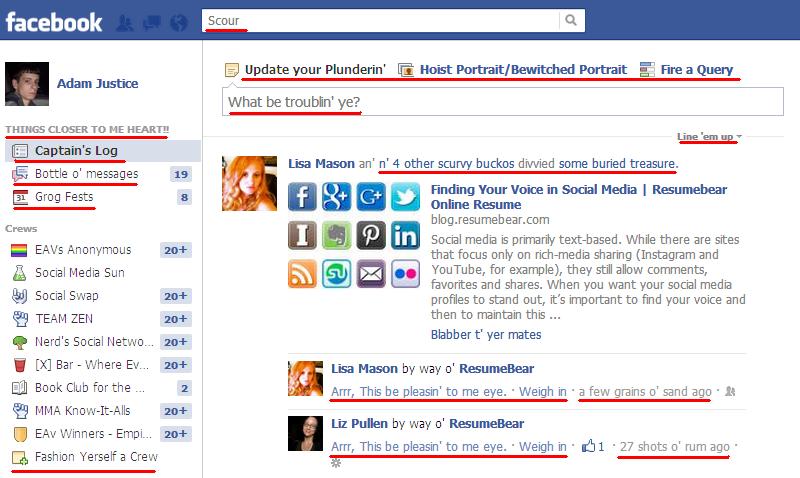
Shiver me Timbers! You've got to be fluent in Pirate and familiar with sailing terms to know what's going on when you set your langauge to English (Pirate).
One of my favorite language settings (but not really) is Leet Speak. Leet Speak is a language that was once used by techies to encode messages so average people couldn’t understand them. Changes like replacing Es with 3s, As with 4s, Ls with 1s, leet speak is basically the aggravating digit swapping you see from teenagers and adolescents combined with a little advanced programming knowledge and Internet culture. For example, in Leet Speak edits are called h4xx and Females are called 54ndw!ch m4k3rz (sandwich makers, which Facebook recently changed to a more politically correct term).
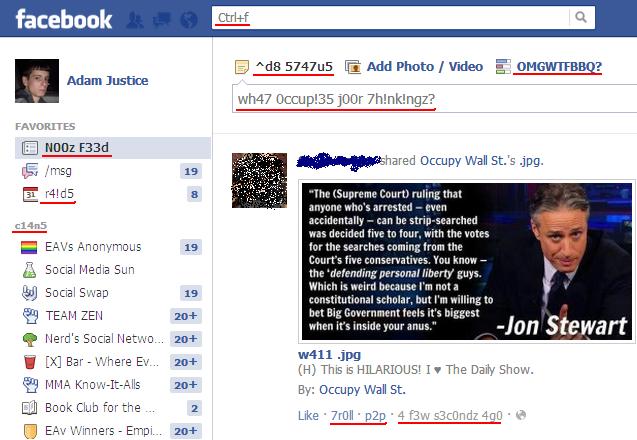
Leet speak is a combination of teenage cool cat, HTML, 4chan and Pig Latin.
Possibly the most outrageous leet speak translation Facebook has applied to the pages when the setting is changed is calling Photos “pr0n”, which is leet speak for pornography. It’s clever, and a little amusing, but it’s unbearable for more than a few minutes.
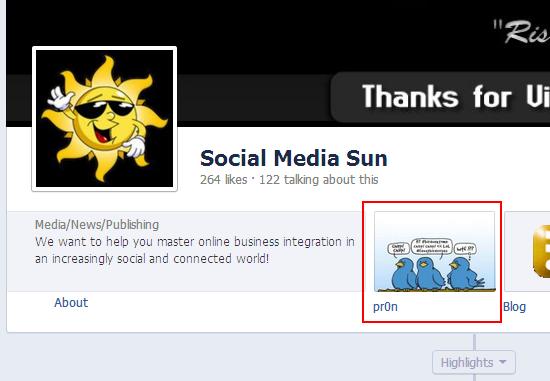
Social Media Sun's pr0n is going to be very disappointing for some.
If leet speak or Pirate talk isn’t quite your thing, Facebook also has a setting for English (upside down). I guess when you’ve answered the most pressing issues and can’t change your application any more without screwing something up (which is the view many users have with Facebook changes) perfecting useless language translations is a way to keep your staff busy! It’s also nice to give pirates a job in linguistics; plundering and pillaging is a hard life! To check out these language settings and more, you can adjust your languages under Account Settings, General, and select edit Language at the bottom of the settings.
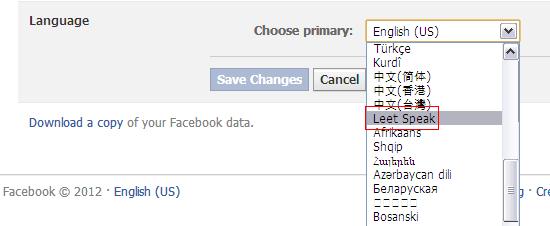
Facebook has so many options for translation that Leet Speak and English (Pirate) are an unknown feature to most users!
See yourself as others see you
The privacy settings included in the Facebook application are extensive and powerful. You can limit status updates, pictures, and your profile to the eyes of only friends, or the public as a whole. You can also further adjust who sees your content by setting up groups, and even excluding individuals at the time of your status update.
If you have a complicated privacy structure, how can you ever really be sure that the wrong people aren’t seeing your private photos? With Facebook’s Timeline viewer, you can switch to the public’s view of your page and see for yourself. You can also select anyone on the Facebook network to check if they are seeing only what you’ve intended for them to see. This is a great ability to check on how your profile appears to your boss, family, or significant other.
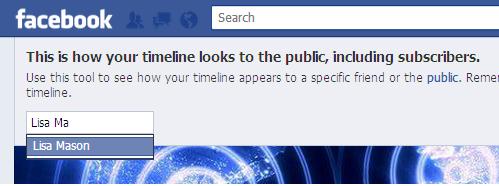
You can check to make sure your friends are only seeing what you want them to see with this innovative feature.
Remember that the only way to be truly sure that your private moments aren’t exposed to the world is by leaving them off of your Facebook profile completely. There are too many ways for the wrong person to get access to the wrong photo, so you’re much better off playing it safe and leaving Vegas in Vegas, and your real life exploits in real life.
Don’t Be a Spokesperson
With the imminent Facebook IPO on the horizon, the advertising team at Facebook has been hard at work trying to come up with clever ways to improve the effectiveness of sponsored ads. They have a world of data to pull from, and it became apparent long ago that friend recommendations were one of the most powerful ways that businesses marketed on social networking sites. Taking a page from the marketers who originally exploited that fact, Facebook has begun tagging ads with your friends have liked the ad, or corresponding Facebook page.
After all, aren’t you much more likely to like a movie because the hot date you had last night wants to go see it next weekend, and you noticed that they’ve “liked” it on Facebook? I don’t know about you, but just because I like a brand or product doesn’t mean I want to be a spokesman for them.
Facebook does have a setting that will remove your endorsement from the ads that can be set up by anyone with an advertising budget. To remove your social actions from ads, go to your “Account Settings” page and select “Facebook Ads” from the navigation. At the bottom of the page there is a drop-box with the option to “Pair my Social Actions with Ads For:” only my friends, or no one. Of course you could always leave it on and solicit endorsements from brands like Old Spice, Preparation H and Vagisil. Only like really embarrassing pages, and charge the companies some free product to keep your name attached to the project!
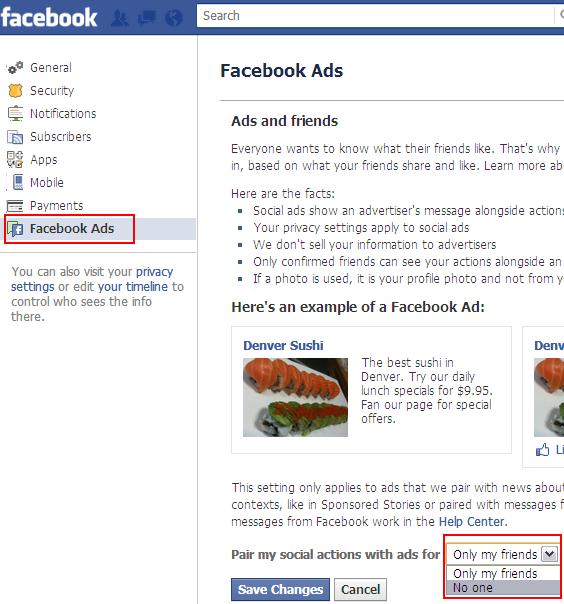
Sorry Lady Gaga, I liked your page so I could get a free download from "Born This Way", but I'm strictly a closet "Little Monster".
Friend Requests Must be Deleted Twice
If you have a Facebook account and have added even a couple of friends from your past, odds are that you’ve received request from people that you’d rather forget than add. Most users will click the option other than add, which is actually “Hide Request”. That friend request isn’t deleted, it’s merely placed in a spot that’s very similar to the “Other Messages” inbox.
This situation could cause problems if you have a jealous spouse snooping through your account, especially if they come across a friend request from that ex lover you made “the video” with in college. You thought you deleted the request, but you actually just filed them all in the “Hidden Requests” folder for future reference.
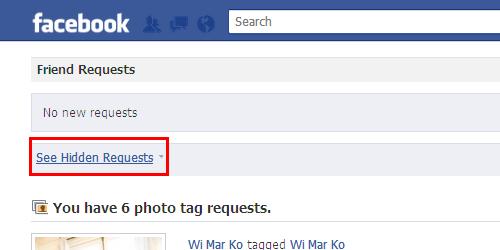
Facebook is so simple and straightforward until it starts hiding messages you wanted to see, and keeping requests you intended to delete.
To completely delete friend requests access your Friend Request page, and scroll down until you come to “see hidden requests”. After moving the requests to that folder, you’ll get the option to delete them for good, and erase every trace that it ever happened.

- Blogging Isn’t a Rocket, It’s More Like a Roller Coaster - August 19, 2025
- Value vs. Expectations: The Fight for Startup Survival - July 31, 2025
- The Evolution of Marketing: From Catalogs to Cat Blogs - November 8, 2022
- How to Make a Tweet This Link - February 5, 2022
- Dramatically Improve Marketing Results with Advanced Analytics - September 20, 2021
- The Next Chapter for Social Media Sun - June 4, 2013
- Optimizing Your FAQ to Maximize ROI - December 5, 2012
- Weapons of Influence and Klout’s Role in Marketing - November 17, 2012

What handy information!! I didn’t know any of this – and I’m on facebook all the time 😉
People just use what they need to: news feed, messages, add friends. Facebook makes design changes that quietly meet their needs, and they just don’t make information available like we do here at SMS 😉 (If you don’t know where to look, it’s even tricky to get back to your advertising campaign to turn off the ads from sucking your money!)
Hi adam
I just read the info. you posted about facebook settings …this was an old post from 2012 but i have a question and thought you would be the perfect person to ask. i want to know if there is a way a spouse can hide their friends list when they logg into face book to make it appear they have no friends. my spouse has fb and when they are signed in the friends section shows empty when i see it . i then notice friend request that say so and so wants to be friends and you have 1 friend in common. we have had some issues in the past and i just dont want to be someones fool. I do appreciate any assistance you may offer. thanks Lacy
Hey, i’m not sure if Adam you replied to your question, it could be that you already know the answer by now but just in case you dont the answer is yes,your girlfriend can hide her friends list, there’s a few options to choose and it can be narrowed down to Not allowing a particular person to see her friends.you can hide pretty much Everything, your comments, statuses, photos. Shares, groups, likes etc. If she didn’t want to to see somethine on her Facebook and without having to delete you All she had to do is block you from seeing the certain post, comment, friend etc. Facebook is slyyy but in all honestly if you have be monitoring/Facebook stalking your girlfriends profile, paranoid about her activities and who she talks on Facebook then shes clearly not the right girl to be with. Just ask her straight out are you blocking me from seeing Stuff Who are you talking to on their ,are you cheating on me. A relationship needs trust, clearly you don’t trust her….
Great post – thanks Adam. You arrrrr awesome!
Thanks for stopping by Eliz!
A lot of stuff I didn’t know about Facebook. Thanks, Adam.
You’re welcome Ernest! Things like these fly under the radar for sure!
Good information for sure – wasn’t aware of the timeline viewer, and we found out about the “other” mailbox the hard way with a client… fortunately it didn’t turn into a disaster but it certainly could have been.
I have known about the other inbox for about 6 months. Even though I DID KNOW, I still didn’t make a routine out of checking it (Facebook sends you notifications for everything important don’t they??)
Last month I was sent an invitation from an executive at Dodge to go to a launch promotion for the new Dodge Dart. Full paid travel, and it was offered to me basically because I blog and talk about cars in social media from time to time. The invite went into the “other” inbox, and I almost missed the opportunity all together. I was lucky to check it – 3 weeks after the message arrived, but thank god it was still in time to RSVP.
The problem is that messages from people who aren’t your best friends are the ones that get sent there. If your best friends have something important to say, they will contact you another way if you don’t reply on Facebook. Someone who is just an acquaintance, they may just think you’re being a prick, or ungrateful in the case of a gift or opportunity. They wouldn’t know other contact methods, and the message would be lost for all eternity.
Thanks for all the information.
the advantage of hiding friend requests is that they cannot re-request since it is still pending. If you delete then they can request again
Good point David. I always considered that a problem either way (not really for me, but someone who was worried about being harassed through Facebook). If you hide it, they know you’re not accepting their friend request for some reason.Privacy on Facebook isn’t a simple subject. Someone with malicious intentions could be scorned by an ignored friend request, and if you have mutual friends, odds are that person knows someone who CAN see your private profile.
Adam 🙂 I knew about ALL of them 😉 lololol
That means you win a cookie!
NO! That means you are on Facebook too much! Want to write for the site? lol
Good info – stuff I didn’t know. Thanks
really interesting and informative , thanks for sharing it.
Just checked my “Other” folder and lo and behold, several legit messages from the last 6 months were tucked away in there. Thanks for this post!
I’m sorry to hear that you missed communications that may have been important, but I’m glad to hear that this article was of help to you, and that you found them!
I didn’t realize that I had messages in the ‘Other’ folder. Thank you for the article!
Hi, if I sent a message that was delivered to the other folder of someone because we had no friends or network in common but I later join the same network, will my message that I already sent appear in their main inbox as unread?
No, it’s not possible to change the join date, but you can backdate posts and events.
Does marking someone as “favorite” give them any special access? And do they know they’re a favorite? Also, I tried finding English Pirate and its not listed. 🙁
Ah, so I figured out the language part, but still need an answer on the “favorite” thing.
Hi,
Can you help me figure out how to do this on facebook: If A and B are not a friend on facebook, but A can view some posts on but B cannot see it, both are not a friend on facebook. How to do that, I hope you could help me 😀
Thanks
This has something to do with each user’s individual privacy settings. You can use this tool to realize what parts of your FB profile are public: http://www.internetmarketingninjas.com/facebook-privacy/
When someone added you on facebook.
then you ignored it or not accept it
does it automatically goes on the follower list?
I received a friends request but then it disappeared, I didn’t get the chance to see the person surname. Is there anyway to find out who has sent friend request then deleted it?
I just had this same thing happen to me today, came here searching for the answer as well, good to see someone already posted it, but not so good to see that you did so over a year ago and no response..
My face book is blocked i cnt chat i dnt knw why?
Really your post is superb and these tricks are new to me, will apply all these tricks in near future.
So if I go on to FB Messenger (downloaded via iTunes) and I send a message to a person that has not been added as a friend – they won’t get the message?!?
Why people still use to read news papers when in this technological globe the whole thing is accessible on net?
A friend said that I posted a nasty message on his Video chat but I know it was not me, he says he erased it, but how can I retrieve to see what I really posted on his video chat, need to prove him wrong, can you help me please, I’M being criticized because of this and I feel devasted that I can’t find that post, Thank you in advance for your help. God Bless.