
 Ever wonder why Facebook doesn’t have a dislike button? Judging by the people I follow and statements they have previously made, I don’t believe the average user wants to spend their time online debating politics and ranting; they want an atmosphere that is a shade lighter than the real world. If you’re an unpleasant friend on a social network, you’re not doing yourself any favors.
Sometimes a like vote doesn’t seem appropriate, even when you have positive feelings for a particular status update. For instance if I posted that I was just involved in a car wreck, you would have to be bitter towards me to like that situation. I always recommend phrasing status updates so that giving a like is an appropriate reaction. Instead of just letting you know I was involved in a car wreck, a better option would be saying that I was in a car wreck, but didn’t suffer major injuries. Life is confusing enough without ambiguous moral math problems on Facebook so it’s best to make it easy on everyone.
Our relationships are often built on common interests. Whether it is tastes in music, a favorite TV show, religious affiliation or a hobby, common interests have always been the cement that makes every type of relationship stronger. We may not have anything else in common except a love for Mexican food, but every time you go out for some pollo bandido you know exactly who to call. Social networking platforms have been largely based upon this principle since the beginning.
Youtubin’ and Negative Reviewin’
The major exception to the lack of negative feedback input methods is the thumbs down button on YouTube. The ability to express dislike has made being hated big business for some. Rebecca Black’s rendition of Friday and almost everything Justin Beiber puts out is flooded with disapproval on YouTube, but they have both managed to persevere through anonymous disapproval to make good in the music industry. Yahoo!’s Chris Chase has made a sports writing career out of being hated by the masses. People who disagree with you will still check in to show their disapproval, much like Howard Stern’s early listeners who stayed glued to the radio just so they could call in and complain when Stern crossed the line.
You can learn a lot from videos that generate a high ratio of approval. They’re usually smart and well produced. If the subject is too smart or too well produced however, it can swing the balloting in the other direction. When there is genuine talent and high quality, less than one percent of You Tubers click on the thumbs down. Anything that is polarizing or controversial will almost always end up with the majority of users disliking the video, even when the majority of people generally agree with the message. There are a number of ways to interpret those results, but it’s really easy to understand how to make videos that will perform as expected after uploading.
It’s an accepted rule that reviews and feedback will almost exclusively come from users who either display extremely positive or extremely negative sentiments. A neutral experience just isn’t worth the effort it takes to review or comment on content or products. Users who have a negative experience are even more likely to vocalize their opinions than those who have a positive one. You’re fighting a losing battle already when you aim to be liked, so why not take a page from Justin Beiber or Rebecca Black and find your way through dissonance?
Conquesting
One of the most successful social media campaigns I’ve witnessed was based on conquesting. Local Response responded to tweets that displayed a negative reaction to AT&T’s wireless service with a coupon worth 100$ off the initiation of a contract with Verizon. The campaign generated a 140 percent click-thru rate and proved the effectiveness of responding to dissonance in social media.
The key factors were dissatisfaction, a popular alternative, a valuable incentive and the ability to target each customer at the exact moment that their hatred for the current service provider was at its peak. Anger and hate are unique in the fact that their amplitude peaks immediately and tapers off over time. Missing the peak by even an hour could have been the difference in being ignored and converting a user to their brand.
Uncharted Territory: The Enemy Graph
A new application developed by students at the University of Texas at Dallas allows Facebook users to list anything with a Facebook presence as an enemy. Enemy Graph has developed a small following of users with similar “hates”. Rick Santorum is currently the enemy graph leader, followed by Westboro Baptist Church, Fox News, Internet Explorer and Justin Beiber to round out the top five.
Anyone with a robust online network can tell you that liberals are more vocal in their displeasure on Facebook than conservatives, but it is a little disturbing to see Rick Santorum and Fox News ranked among racism and the Westboro Baptist Church, which are both universally disliked. Hating Justin Beiber and Internet Explorer have become Internet memes, and are in line with the sentiments expressed on YouTube and popular image boards.
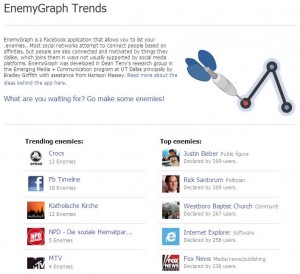
The new Facebook App Enemy Graph lets you dislike anything with a Facebook presence.
All of these topics have created bonds that represent the polar opposite of common interest relationships. People’s hatred for certain things have the same ability to spark conversations, represent some kind of common ground and give the same amount of information about someone’s personality that their interests do. Enemy Graph hopes to explore the hate relationship by helping people connect with others who have similar dislikes. Since Facebook doesn’t even offer a dislike button, it’s very likely that they will suspend the Enemy Graph application on the grounds of philosophical differences.
Don’t Social Media Hate; Hate Social Media
Surprisingly the most prevalent topic that is hated through social media is social media itself. It’s not uncommon to see a post from one of your friends complaining about a change to the Facebook layout on your Facebook feed. When major changes roll out you could see 20-50 such posts in a single day.
iContact once found that 25 percent of small business owners hate social media. They feel overwhelmed and dislike the possibility of facing a media disaster that is out of their control. Louis C.K., a comedian who is popular on Twitter has said that he “… kinda hates social media”. Even though he has used Twitter to gain notoriety and stay in touch with his fans, he once admitted on the Conan O’Brien show that he just uses Twitter to sell his performances.
Even individual users express their ire in frequent “Things I Hate about Social Media” blog posts. Whether its Farmville requests or duck face pictures, everyone hates something. It’s hard to ignore cynical status updates and Twitter hash tags in the vein of #WhyIHateFacebook. The most popular topics on social media blog posts include classics like “I Hate Klout and am opting out” and “Why I Hate Susan G. Komen Today”. Hate pervades everything we do in social media, but the majority of people seem to ignore it or pay it less attention (unless Facebook’s EdgeRank algorithm is hiding posts with negative verbs). Speaking of EdgeRank, with semantic indexing and advances in programming we may see a day soon when users have the option to filter out negativity in their online experience. Judging by the amount of car wrecks and homicides on the six o’clock news, I don’t think it will be as popular as you’d expect. The dark is needed to make the light brighter, but reality is almost always offered up in shades of grey.
To Know Hate is to Better Understand Love
Even with all of this evidence that hate can build relationships and has been proven as a powerful marketing ally, I still find myself disgusted with negativity when it surfaces on social media. My number one hate is passive aggressiveness, and constantly expressing displeasure is a close second. I do however think that it’s an important side of the human psyche to understand if you’re going to deal with the public. When you understand what people hate, you have a much better shot of producing something that goes over well.
UPS recently produced a commercial depicting Christian Laettner’s last second score in a game against the University of Kentucky in the early 90s. As a Kentucky resident, I was well aware that there is a large group of people who have an intense emotional response when that game is mentioned. Residents here can remember watching the game live, and the fury that they felt as UK was upset to finish off what was otherwise a Cinderella year returns when they show that clip in March. It’s easy to misunderstand negative feelings when you do not share them, but at the very least research your topics and make yourself aware of lingering hatred.
Do you think hate has a place in social media? Should Facebook install a dislike button? Does having common dislikes make relationships based on positive interests stronger?

- The Evolution of Marketing: From Catalogs to Cat Blogs - November 8, 2022
- How to Make a Tweet This Link - February 5, 2022
- Dramatically Improve Marketing Results with Advanced Analytics - September 20, 2021
- The Next Chapter for Social Media Sun - June 4, 2013
- Optimizing Your FAQ to Maximize ROI - December 5, 2012
- Blogging Isn’t a Rocket, It’s More Like a Roller Coaster - November 19, 2012
- Weapons of Influence and Klout’s Role in Marketing - November 17, 2012
- The Biggest Problem With Inbound Marketing Blogs Today - November 16, 2012

It’s always more fun to keep things sunny on social media, but I think it’s unwise to be a pushover on any medium. On my bio it says allergic to BS, and I mean that. I’m exactly the same online and offline. I’ll give anyone the shirt off my back if they were in need, but I will stand up for myself and say exactly how I feel IRL and on any social medium media. If people were as transparent, there would be a lot less hatefulness online. In actuality, some people enjoy the anonymity to act like total jerks, because they are usually miserable and harbor negativity and hate in real life. They use social media as a medium for their toxic thoughts that would alienate them in the real world. It’s very sad.
P.S. Awesome post, Adam!
Thanks Amberr. I agree, it is much nicer to have a positive environment. I feel like some people thrive off of negativity though and it’s always obvious when anger is fuel for something that someone has written. I think you’re probably right about the parallel between real life problems/ lack of self esteem with a negative online attitude. Then again, I think some people are wired to hate things more. They realize that people don’t want to hear about it all the time, so they jump at the chance of a KONY video or any other hate mob that allows them to be the dissenter that they genuinely are.
It’s really too complicated to speculate on though, and no one who fits the bill is going to like being approached with questions (I’m sure they don’t think they’re passive aggressive or a hater). The real question is about genuine dislikes though; does common dissonance have the same potential for relationship building as common interests, if it is presented in a constructive, honest and straightforward manner?
I’m not sure there’s a place for hate, period. If it’s something you dislike, argue your position respectfully or walk away. With social media, nobody makes you read anything; you can choose whether or not to click on the button so if it’s something you don’t like, don’t go there. I think there’s a serious problem in society currently; there’s too much negativity. The problem with negativity is that it pulls you down, not only those toward whom it’s directed. I don’t mean that we should be pushovers; on the contrary, I think we need to have our eyes wide open, our instincts alerted, and a healthy dose of skepticism. But we can get our points across without being rude or hateful. I teach online education classes and my husband tells me I’ve perfected the art of slapping wrists in a positive way…I guess that’s what I’m talking about. Hold people accountable for their choices and actions but do it in as positive way as possible.
Rhia at http://Dr-Rhia.com/blog
I get what you’re saying Rhia, but one of the things that pisses me off most is an attitude my brother takes when he wants to criticize. He tries to be nice about it… but it comes off as smug, and it is much worse to me than being straightforward about it.
I am all about the positive side of things, but there is too much bullshit presented online to leave everything unchallenged. One of the biggest mistakes I see made on a daily basis is undeserved positive re-enforcement. A friend of mine is convinced that they’re qualified to do all these things that they have very little understanding of. No one wants to be honest because they have been re enforced so long that they’re fully convinced. It has already hurt their development substantially, and continues to cause a lot of wasted time. It probably started from reading things that weren’t totally accurate, and was nurtured by other people who read the same book so to say. A lot of potential wasted, and it’s so cyclical that it’s probably irreversible now. What makes it so disastrous is that the same effort directed appropriately could have paid huge dividends, no matter what path someone chooses.
It’s important to consider the context of hate here. If both you and I dislike lemonade, so we decide to invent a lemonade that isn’t as tart, we become the inventors of rasberry lemonade. Hate isn’t always in the extreme, and we’re exploring the possibility that relationships can be forged just as easily with common dissonance as they can with common interests. We know that negative emotions are powerful marketing opportunities, but where does the value start and stop? Where is the line we draw? I would like to know more about your “slapping wrists in a positive way” :).
I have always wondered where the dislike button was on Facebook. There are many times one will post a status message that isn’t likable but with the current system the status gets likes. I for one dislike “Liking” a bad event or news article.
I can also relate some with customers in the field. When describing a potential setback, I usually will start off with a positive about this going well or right. It seems to receive a better response than immediately harping on what is going wrong.
It is often just a sign of support. Events that aren’t necessarily positive spur strong responses, and people want that quick “like” action to register a response with the OP, regardless if it’s appropriate semantically. It goes back to the beginning of the article where I suggest phrasing status updates so a “like” is appropriate.
The more I think about it, a dislike button wouldn’t be appropriate for the kind of events and status updates we’re referring to here. Disliking something is negative on more levels than just saying “I wish this didn’t happen to you”. Liking posts helps their EdgeRank, and it’s safe to assume that disliking posts would hurt it. It opens up a whole can of worms that Facebook has avoided. What is interesting is that Facebook users who I’ve heard characterized as “dumb” by people quoting studies realize (either consciously or on a sub-conscious level) the positive connotations that a like has, even when attached to bad news. For example the large outpouring of support that was received through comments and likes during my niece’s funeral helped the posts trend so family would receive updates and have the chance to show support themselves.
Right. Social intelligence = being positive. Or in other words, if you dislike something – ignore it!
An interesting article Adam. Better say nothing than be negative? surely by not responding we consent to the action or opinion and so it goes on.
I know a few people who have made a gig out of hating stuff. 80% of their Facebook posts will start with “You know what I hate?” (I always think “No, but I bet you’re going to tell me”), and they’re more likely to cover other people’s failures than their own successes in their blog.
When your opinion is popular, it doesn’t matter if it’s negative; support will surface. Even if it’s unpopular, have you ever heard the saying “No news is bad news”? Howard Stern generated much more awareness through his detractors than his fans.
Here is the deal with social media; it’s full of opinionated liberal know-it-alls that weigh in on everything. A large percentage of the people discussing advanced topics aren’t educated on what they’re hating on. Like politics – there are several reasons why you would want to take a progressive stance on healthcare, but the changes included in Obama’s reform are terrible for our healthcare system, and it’s going to raise costs substantially (kinda funny that they called it the affordable healthcare bill). Normal people don’t understand the economics of our healthcare system, but they know that they don’t like how it works now, and they know they’re registered as a Democrat. That’s enough for them.
It’s counter productive to make negative changes just because a system isn’t working perfectly at the moment. Perfect is the enemy of good enough, and progress is the enemy of positive reform. Not to mention that social media users are about 90% less influential than they think they are. A very small percentage of causes and organizations get to experience viral sharing, and regular people are mostly oblivious to the things that trend on Facebook.
Saying something on Facebook rarely has an effect. In a world were thousands of actins could have an effect, expressing your opinion on Facebook is a type of arm chair activism that has many more negative consequences in the long run than immediate effect. You’ll do nothing but energize the opposition. If a single one of them takes real action, they’ll counteract thousands of whiny Facebook users. Being negative on Facebook only works to create opposition for your ideas, and it decreases your real influence a little every time. You’ll also alienate the people that are tired of hearing it – which just so happens to be the influential ones who could have an effect. Even with an overwhelming response from users who love to hate on Facebook, it will do nothing except give you the perception of sparking response.
If you pay attention, you’ll see that this is the case more often than not when it comes to original negative reaction in social media.
You also have to keep in mind, for every negative response, there is usually an equal, but opposite, positive response. Let’s say that I dislike Apple products. Instead of posting a rant about the problems with the new iPhone, I could write an essay about the virtues of upcoming Microsoft products. The response you’ll get from readers will vary short-term, but the associations they make with your writing will give you a long-term edge.
“Here is the deal with social media; it’s full of opinionated liberal know-it-alls that weigh in on everything.”
That is so much EXTREME bullshit. The primary issue is that SOME people, usually those who most people would describe as “liberal” or “progressive”, actually CARE about (most) things, sometimes enough to speak out about them.
Whereas most people who most people would describe as “conservative” (and the like) don’t really care about much of anything, except themselves, and what does or might directly affect them.
And much of what SOME people like to interpret, perceive, and think of as “negative” is actually simply “reality” and the like, or something they simply do not like, and therefore it’s “negative”.
Your ‘article’ is WAY off the mark in most ways.
This also makes me wonder about the role of conduct in social media and online communities. If you look at up/down voting communities like Youtube and Reddit (and forums and message boards such as 4Chan), users are often identified by handles rather than personal names, which I think makes users more comfortable with voicing a negative response (or engaging in more volatile acts like flaming or trolling). Would such behavior ever happen on a platform like Facebook — where your face and named are tied to the statements and actions you make?
In e-commerce, if I buy a product that is bad and hurt my feeling, I will definitely “hate” it to prevent it from cheating other customers. I think that’s the value of “hate” is to tell which is good by low rate of hating.
So Much Hate! So Much Anger! BS Sells! Over 99% of what we read is BS. The Media, that’s you, are failing your social responsibility for willfully publishing Organized Mob Hate BS comments about third parties to gain exposure and profit. This phenomenon is now known as riding the BIEBER bandwagon because BIEBER sells.
Hate Kills. Hate is Ugly. Are you a hater? You can change. Don’t be a hater. Don’t Kill. Take back control of your emotions and always question what you read. No one is perfect. We all have flaws. Choose to be positive. It’s a personal choice. It’s your choice. A positive approach will serve you well in your personal and family lives. Get honest. Help others who could use support. Share these vibes. SUP 1 702 421 3511 disnetinc.com/marydtn9.htm
You forgot indifference. There are those of us who simply do not give a stuff about social media or the boring idiots who frequent it.
Social media is of no consequence.
The reason why I hate social media is because of the posts on the fan pages that is only for attention, gossiping, bashing or bullying other people, fans, etc. There’s are a lot of annoying teenagers in my country that posts bullshit, memes, gossips and I hate it! Too much selfies is annoying too! Blame it on the selfie song of The Chainsmokers and also the mainstream pop artists like Miley, Ariana, etc.